Annual Report to Parliament 2026
ISSN 2563-2981
Table of contents
Message from the Minister

Minister of Indigenous Services Canada
I am pleased to present Indigenous Services Canada's Annual Report to Parliament for 2026. This year's Report highlights progress achieved in partnership with First Nations, Inuit and Métis, guided by the inherent right to self-determination and grounded in a commitment to reconciliation. Across the country, we are seeing what is possible when Indigenous Peoples have greater control over the decisions, services and systems that affect their communities.
This year, progress can be seen in the growing strength of community-driven solutions and Indigenous-led approaches to development. First Nations, Inuit and Métis are expanding their participation in Canada's economy through employment, entrepreneurship and major projects, clean energy initiatives, community-owned businesses and innovation. These efforts are contributing to build strong, culturally grounded and sustainable economies that reflect the priorities, knowledge and aspirations of Indigenous Peoples.
This same commitment to self-determination is guiding how services are designed and delivered. Nowhere is that more important than in the care of children and families. This year marked important progress as more First Nations exercised their authority to determine how their children and families are cared for. In Ontario, the final agreement with the Chiefs of Ontario and Nishnawbe Aski Nation represents a major step toward a First Nations-led system of child and family services, backed by $8.5 billion over nine years. These are more than changes to how services are delivered. They are about First Nations reclaiming responsibility for their children, grounded in their own laws, cultures, families and communities. And we are seeing what happens when First Nations lead. Indigenous-led approaches can help prevent children from entering care in the first place, reduce the time they spend in care when placement is necessary, and support more children in returning to their families and communities sooner.
That work continues alongside the long-term reform of the First Nations child and family services across the country and support for First Nations-led education systems that give communities greater control over how their children learn and grow. Jordan's Principle also continued to help ensure that First Nations children received the products, services and supports they need, when they need them.
While meaningful progress has been made, much work remains to close socio-economic gaps and advance the transfer of services to Indigenous Peoples. Our work must continue to move toward a future where Indigenous Peoples have the authority, capacity and resources to lead the services and institutions that affect their lives. That is what self-determination requires, and it is how we build lasting change.
The progress highlighted in this report reflects the dedication of Indigenous partners and communities across the country. I want to express my sincere thanks to the leaders, Elders, youth, organizations and frontline workers whose commitment supports Indigenous Peoples every day. Your leadership, knowledge and partnership and determination are driving this work forward. Our role is to be a strong partner in that work and to keep moving together toward a future where Indigenous Peoples have greater control over the decisions that shape their communities and the generations to come.
The Honourable Mandy Gull-Masty
Minister of Indigenous Services
Introduction
The Department of Indigenous Services Act requires the Minister of Indigenous Services to table an Annual Report to Parliament detailing:
- the socio-economic gaps between First Nations, Inuit, and Métis individuals and other Canadians and the measures taken by the department to reduce those gaps; and
- the progress made towards the transfer of responsibilities.
The 2025-26 Annual Report to Parliament represents the seventh report produced under this legislative mandate. It also responds to a related commitment under the United Nations Declaration on the Rights of Indigenous Peoples Act Action Plan (measure 1.20). In addition, since 2025, this report also serves to fulfill requirements under the Indian Act Amendment and Replacement Act to report annually on work undertaken in partnership with First Nations and other interested parties to develop new legislation to replace or amend the Indian Act.
With a focus on quality of life improvements and long-term economic development, the report highlights Indigenous Services Canada's commitment to supporting self-determination and systemic change. It emphasizes the ongoing shift from government-led service delivery to Indigenous governance, while acknowledging that persistent gaps continue to shape outcomes across Indigenous communities.
In 2025-26, departmental efforts contributed to meaningful progress toward closing socio-economic gaps and advancing the transfer of control of services to Indigenous partners. Indigenous communities saw strengthened prevention-based family supports, increased access to education and culturally relevant programming, and improvements in housing, infrastructure, connectivity, and urban service access, alongside growing participation in the labour market and economic opportunities, including major projects. At the same time, Indigenous-led systems continued to advance, with progress reflected in Indigenous data governance and in First Nations-led health governance models, increased jurisdiction in child and family services, and strengthened leadership in infrastructure, land and emergency management.
These efforts also supported the implementation of the Federal Pathway to Address Missing and Murdered Indigenous Women, Girls, and 2SLGBTQQI+Footnote 1 people by advancing initiatives that address both immediate needs and underlying systemic causes of violence including investments in community infrastructure, education, employment and skills development, Indigenous women's entrepreneurship, distinctions‑based mental wellness strategies, child and family services reform, family violence prevention and community safety and wellbeing.
Although progress is being made, lasting colonial impacts, a rapidly changing environment, increasing environmental challenges, and persistent socio-economic gaps highlight the need for sustained and coordinated action to ensure that improvements are experienced equitably by Indigenous communities and organizations across the country.
1.0 Indigenous Economic Participation and Contributions
First Nations, Inuit and Métis Peoples play a significant and growing role in Canada's economy through increasing participation in employment, entrepreneurship, and a broad range of industries. These contributions help advance the Indigenous economy and support economic participation and reconciliation, ultimately strengthening socio‑economic outcomes for Indigenous Peoples.
The Indigenous Peoples Economic Account produced by Statistics Canada provides macroeconomic indicators of Indigenous economic activity, including Indigenous Gross Domestic Income and the number of jobs held by Indigenous PeoplesFootnote 2. The latest Indigenous Peoples Economic Account data for 2012 to 2023 shows sustained growth in Indigenous income generation and employment. These trends reflect meaningful progress in strengthening economic participation and expanding opportunities for First Nations, Inuit and Métis Peoples.
1.1 Indigenous Gross Domestic Income
Indigenous Gross Domestic Income measures the income generated by Indigenous workers and Indigenous-owned businesses across the Canadian economy and provides a key indicator of the scale and growth of the Indigenous economy.
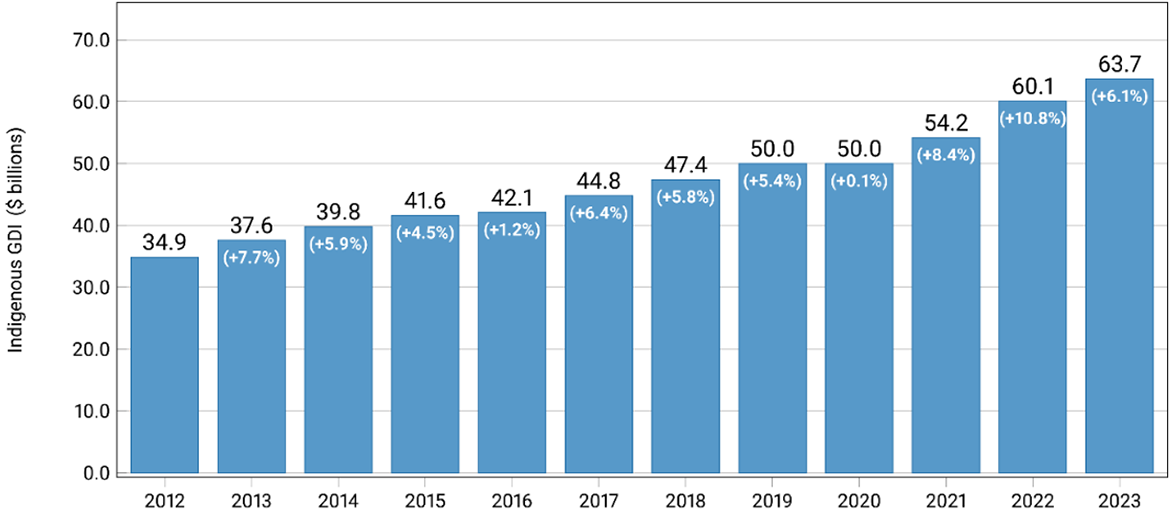
Text alternative for Figure 1: Indigenous Gross Domestic Income levels and growth rates between 2012 and 2023
Figure 1 illustrates Indigenous Gross Domestic Income levels and growth rates between 2012 and 2023.
| Year | Indigenous Gross Domestic Income (in Billions) | Increase from Previous Year |
|---|---|---|
| 2012 | $34.9 | N/A |
| 2013 | $37.6 | 7.7% |
| 2014 | $39.8 | 5.9% |
| 2015 | $41.6 | 4.5% |
| 2016 | $42.1 | 1.2% |
| 2017 | $44.8 | 6.4% |
| 2018 | $47.4 | 5.8% |
| 2019 | $50.0 | 5.4% |
| 2020 | $50.0 | 0.1% |
| 2021 | $54.2 | 8.4% |
| 2022 | $60.1 | 10.8% |
| 2023 | $63.7 | 6.1% |
Indigenous Gross Domestic Income reached $63.7 billion in 2023, representing approximately 2.3% of Canada's total Gross Domestic Income. Between 2012 and 2023, Indigenous Gross Domestic Income rose from $34.9 billion in 2012 to $63.7 billion in 2023, an increase of 82.6%, corresponding to an average annual growth rate of about 5.6%. This sustained growth has been broadly aligned with overall economic trends in Canada, including a temporary slowdown during the COVID-19 pandemic followed by a rebound beginning in 2021 (+8.4%), accelerating in 2022 (+10.8%), and continuing in 2023 (+6.1%). These trends reflect the increasing strength and contributions of Indigenous economic activity across sectors.
1.2 Indigenous Peoples in the Labour Market
In absolute terms, the number of jobs held by Indigenous Peoples provides an important measure of participation in Canada's labour market and contributes directly to income generation and economic growth.
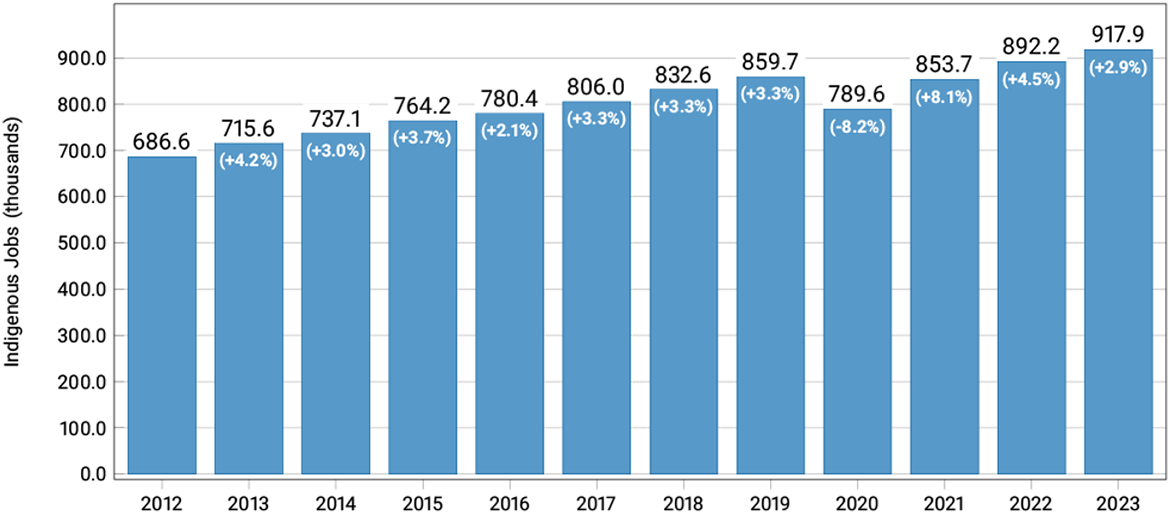
Text alternative for Figure 2: Jobs Held by Indigenous People, Canada, 2012–2023
| Year | Indigenous Jobs (thousands) | Difference from Previous Year |
|---|---|---|
| 2012 | 686.6 | N/A |
| 2013 | 715.6 | + 4.2% |
| 2014 | 737.1 | + 3.0% |
| 2015 | 764.2 | + 3.7% |
| 2016 | 780.4 | + 2.1% |
| 2017 | 806.0 | + 3.3% |
| 2018 | 832.6 | + 3.3% |
| 2019 | 859.7 | + 3.3% |
| 2020 | 789.6 | - 8.2% |
| 2021 | 853.7 | + 8.1% |
| 2022 | 892.2 | + 4.5% |
| 2023 | 917.9 | + 2.9% |
In 2023, Indigenous Peoples held approximately 917,900 jobs across sectors of the Canadian economy, representing 4.4% of total jobs in Canada. Between 2012 and 2023, Indigenous employment rose from 686,600 jobs to 917,900, an increase of 33.7% over the period.
This growth in Indigenous jobs closely aligns with increases in Indigenous Gross Domestic Income, indicating that rising employment has been an important driver of Indigenous economic contributions.
While First Nations, Inuit and Métis participation is present across most sectors of the Canadian economy, a consistent group of industries forms the backbone of Indigenous employment and Gross Domestic Income, including public administration, health care, construction, real estate, and resource-based industries such as mining and oil and gas extraction.
- Public administration is the largest contributor to Indigenous economic activity. In 2023, the sector generated $13.0 billion in Indigenous Gross Domestic Income (20.4%) and supported 146,200 jobs (15.9%) nationally.
- Health care and social assistance supported 127,700 Indigenous jobs (13.9%) and generated $6.7 billion in Gross Domestic Income (10.5%), reflecting strong Indigenous participation in health and community services across Canada.
- Construction also represents a major pillar of Indigenous economic activity, producing $6.2 billion in Gross Domestic Income (9.7% of total Indigenous Gross Domestic Income) and supporting 89,400 jobs.
- Real estate and rental and leasing generated $7.3 billion in Indigenous Gross Domestic Income in 2023 (11.5% of the national total) while employing a comparatively smaller number of workers (15,100 jobs, or 1.6% of Indigenous employment).
- Resource-based industries, particularly mining, quarrying, and oil and gas extraction, generated $3.2 billion in Gross Domestic Income and supported 23,900 Indigenous jobs, particularly in western and northern Canada.
Indigenous employment is also broadly distributed across service sectors:
- Retail trade (97,100 jobs)
- Accommodation and food services (65,000 jobs)
- Educational services (62,400 jobs)
- Transportation and warehousing (40,300 jobs)
- Professional, scientific and technical services (31,700 jobs)
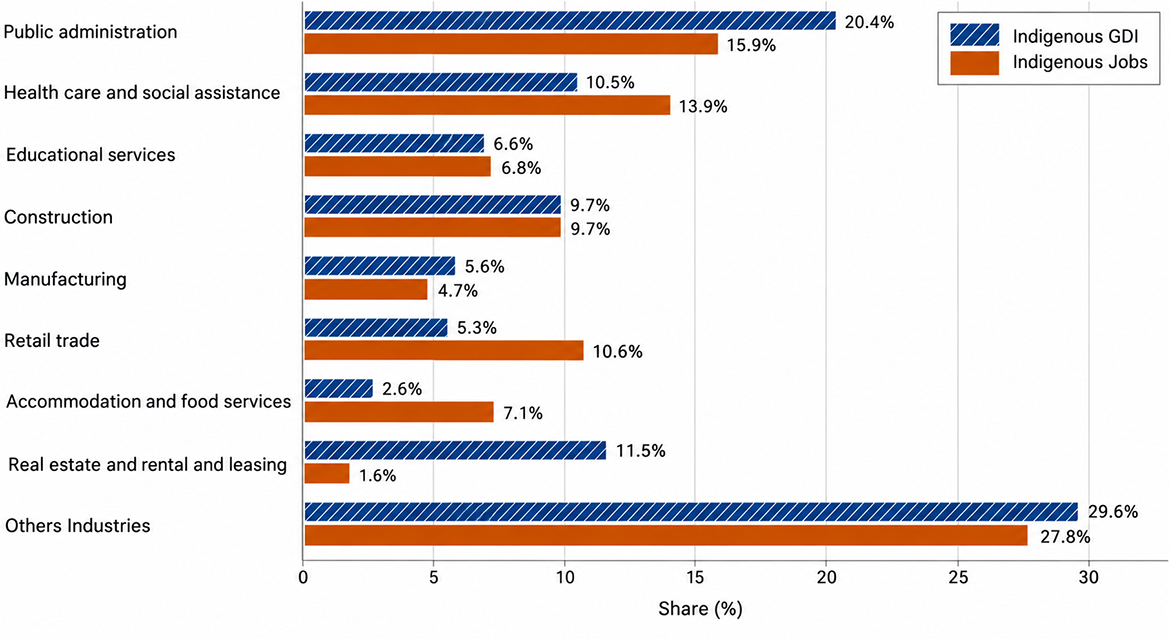
Indigenous Gross Domestic Income Source: Statistics Canada, Indigenous Peoples Economic Account (IPEA), 2012–2023; Indigenous Services Canada custom tabulations. "Other industries" includes all remaining sectors not shown individually in the figure, such as agriculture, utilities, wholesale trade, transportation and warehousing, finance and insurance, and professional services.
Text alternative for Figure 3: Distribution of Indigenous Gross Domestic Income and Jobs by Industry, Canada, 2023
| Jobs by Industry | Indigenous Gross Domestic Income (Share %) | Indigenous Jobs (Share %) |
|---|---|---|
| Public Administration | 20.4% | 15.9% |
| Health care and social assistance | 10.5% | 13.9% |
| Educational Services | 6.6% | 6.8% |
| Construction | 9.7% | 9.7% |
| Manufacturing | 5.6% | 4.7% |
| Retail trade | 5.3% | 10.6% |
| Accommodation and food services | 2.6% | 7.1% |
| Real estate and rental and leasing | 11.5% | 1.6% |
| Other industries | 29.6% | 27.8% |
Figures 2 and 3 highlight distinct patterns of Indigenous employment and income across industries. These differences reflect how industries contribute to income generation and employment, with sectors such as public administration, health care, and construction driving both, while others contribute more unevenly.
While these trends highlight sustained growth in Indigenous economic participation, they do not capture broader socio-economic outcomes, such as income, employment, and housing, which are assessed through Census-based indicators.
2.0 Progress Toward the Transfer of Responsibility of Services and Closing Socio-economic Gaps
The sectionsFootnote 4 that follow present progress made by Indigenous Services Canada over the 2025-26 fiscal year, organized by service area. They outline key programs and initiatives that have continued to advance the department's mandate to close socio-economic gaps between Indigenous and non-Indigenous Peoples in Canada and to support the transfer of control over services to Indigenous partners. While not all programs contribute equally to both objectives, each advance at least one aspect of this mandate. Emphasis is placed on measurable results and outcomes, demonstrating how these efforts are supporting increased Indigenous self-determination.
2.1 Service Area: Health
2.1.1 Jordan's Principle
Named in honour of Jordan River Anderson from Norway House Cree Nation in Manitoba, Jordan's Principle is a human rights principle and legal obligation under the Canadian Human Rights Tribunal that ensures that First Nations children do not experience gaps or delays in accessing government-funded health, social or educational products, services and supports, and that they are not denied government services due to their identity as First Nations.
Since 2016, nearly $10.5 billion in Jordan's Principle funding has been invested to meet the needs of First Nations children, and more than 10 million health, social and educational products, services, and supports have been provided to address children's specific health, social, or educational needs. However, requests through Jordan's Principle have grown at an extremely fast pace, most notably in the last few years, causing delays in processing requests and resulting in a significant backlog.
Indigenous Services Canada is working on a number of actions to eliminate the backlog of requests and improve the administration and service delivery of Jordan's Principle, including reviewing service delivery models and operational processes as part of ongoing efforts to improve delivery, support long-term sustainability and prevent future backlogs.
Jordan's Principle staff continue to work diligently to clear the existing backlog and to process new requests. These efforts have resulted in measurable progress being made, with the backlog of requests decreasing steadily over the past several months. To date, the backlog of requests pending intake has been reduced from 7,316 in June 2025 to about 500 as of March 2026 (93% reduction). As of March 2026, Indigenous Services Canada had reduced the backlog of urgent requests from approximately 5,000 in June 2025 to under 200 (>95% reduction).
While progress has been made in addressing urgent requests, overall demand remains high, and continued efforts are required to improve processing times and ensure the long-term sustainability of the initiative.
2.1.2 Inuit Child First Initiative
The Inuit Child First Initiative ensures Inuit children in Canada have equal access to essential government funded health, social and educational products, services and supports they need.
Since its launch in 2019, the Government of Canada has committed $624.2 million to the Inuit Child First InitiativeFootnote 5. From April 1, 2019, to January 31, 2026, 39,151 requests were approved for Inuit children for 343,977 products, services, and supports through the Inuit Child First Initiative. These include health services, mental wellness supports, and educational resources that contribute directly to improved well-being and development outcomes.
By reducing barriers to access, the Initiative is helping to address disparities in service availability and improving the timeliness and responsiveness of supports for Inuit children and families, while advancing a longer-term shift toward Inuit-led design and delivery of services.
In 2025-26, $115 million in funding was renewed for the Inuit Child First Initiative until March 31, 2027, to help ensure Inuit children and families continue to access essential government-funded health, social, and educational products, services and supports while Canada and Inuit partners continue to co-develop an Inuit-led, long-term approach. In July 2025, a new Inuit Child First Initiative Operations Table was established to provide a regular forum between Indigenous Services Canada and Inuit partners to discuss operational issues. Indigenous Services Canada remains committed to the co-development of a National Framework which will lay the groundwork for increased Inuit control over the design and delivery of services, consistent with the Inuit Nunangat Policy and the broader objective of advancing self-determination.
2.1.3 Primary Healthcare
Indigenous Services Canada funds and delivers primary healthcare services through nursing stations, hospitals, oral health services, home and community care, and digital health technologies across First Nations and Inuit communities. The department works to provide high-quality, culturally safe, and accessible health services in 79 nursing stations and two hospitals across remote and isolated First Nations on reserve, where provincial health services are limited. Indigenous Services Canada also supports access to culturally appropriate oral health services across 355 First Nations and Inuit communities, improving access to services and reducing oral health disparities. Additionally, to support First Nations as they adopt virtual healthcare technologies, the eHealth program provides funding to support the use of digital health technologies for First Nations on reserve.
In 2025-26, in addition to current and ongoing funding, the Government of Canada announced renewed funding of $400 million over five years (starting in 2026-27), or $80 million annually, to sustain essential front-line healthcare services and fundamental digital health infrastructure in 79 remote and isolated First Nations communities. This funding will support service continuity through interdisciplinary health teams established through time-limited funding announced in Budget 2021.
Indigenous Services Canada's accreditation program advances capacity for health service delivery in First Nations communities by facilitating the uptake of quality improvement and health services accreditation activities, increasing access to high quality services that meet national standards. As of April 1, 2025, the first of 50 department-run nursing stations have achieved accreditation, with five additional sites (three in Alberta and two in Manitoba) in the early stages of the process. A broader, nationally coordinated planning is underway to assess all nursing stations against accreditation standards and support a phased approach to full program accreditation.
2.1.4 Mental Wellness
The Mental Wellness Program provides community-based funding to support access to mental wellness services primarily in First Nations and Inuit communities. Services include, but are not limited to, life promotion and suicide prevention, trauma-informed health and cultural supports, local multidisciplinary community-based mental wellness teams, substance use prevention and treatment programs, and crisis line services. Community-based services are designed and delivered by communities and respond to their unique needs and priorities.
In 2024-25, approximately 196,000 Indigenous Peoples accessed cultural and emotional supports, with over 960,000 total service interactions, while approximately 15,000 unique clients accessed over 226,000 counselling sessions through the Expanded Trauma-Informed Health and Cultural Support Program.
In 2025-26, funded crisis lines responded to more than 148,000 calls and online chats. Additionally, each year, approximately 5,000 individuals access substance use treatment through the network residential treatment programs funded by Indigenous Services Canada.
In 2025-26, the Government of Canada announced renewed funding of $630.2 million over two years through Budget 2025, starting in 2026-27. These investments will continue to support the availability, accessibility, quality, and effectiveness of First Nations- and Inuit-led, culturally grounded, and community driven mental wellness services and supports.
2.1.5 Tuberculosis Elimination in Inuit Nunangat
Indigenous Services Canada continues to work with Inuit partners to support Inuit-led approaches that address rates of tuberculosis in Inuit Nunangat.
Tuberculosis is a serious and highly transmissible respiratory disease that continues to disproportionately affect Inuit. In 2024, the reported rate of active tuberculosis among Inuit living in Inuit Nunangat was 246.4 cases per 100,000, over 40 times the rate of the overall total Canadian population (6.1 cases per 100,000) and over 600 times the rate of the Canadian-born non-Indigenous population (0.3 per 100,000).
In February 2026, the Government of Canada announced $27 million of renewed funding over five years to continue to support efforts to eliminate tuberculosis in Inuit Nunangat, beginning 2026-27.
Since 2022, the department's National Public Health Surge Team has responded to 14 requests for assistance in Inuit Nunangat communities, primarily in Quebec and Nunavut, providing a total of 157 weeks of surge support. The team has been mobilized on a short-term basis to assist with screening, diagnosis and treatment in communities facing outbreaks and health human resource shortages. Tuberculosis treatment requires sustained, resource-intensive care, including daily direct observed therapy, frequent clinical monitoring, and long-term follow-up. Community outbreaks typically persist for years and require consistent and well-coordinated capacity, stable resources, and community trust to achieve meaningful progress.
2.1.6 Home and Long Term Care
Indigenous Services Canada's Home and Long Term Care Program is inclusive of the First Nations and Inuit Home and Community Care and Assisted Living programs, aiming to support First Nations and Inuit having a better quality of life in the setting of their choice.
First Nations and Inuit Home and Community Care
The First Nations and Inuit Home and Community Care program provides a continuum of nursing, case management, and supportive services that support individuals with chronic conditions, disabilities, or age‑related needs to remain safely in their homes and communities. The program plays a central role in supporting aging in place, reducing reliance on institutional care, and improving overall quality of life. Services are grounded in community‑based approaches that reflect local priorities, cultural practices, and holistic wellness models. Demand for care continues to grow due to demographic shifts and increasing complexity of care needs, sustained investment, and workforce stability.
In 2024-25, the department's Home and Long term Care program supported up to 16,500 clients, including about 850 individuals in long‑term and continuing care facilities and roughly 15,500 in-home care clients through the Assisted Living program. In 2025-26, the First Nations and Inuit Home and Community Care program supported 396 home care teams serving over 30,000 clients. This work also includes $5.8 million of funding in continuing care capacity building projects, as well as supporting nine Indigenous‑led palliative care initiatives. Through Knowledge Sharing Circles and national practitioner networks, the program strengthened collaboration, improved care pathways, and advanced best‑practice approaches grounded in Indigenous priorities.
Further, the program supports service transfer and can effectively complement the department's Health Transformation Initiatives. As a transferred, fully First Nations-led program, the First Nations and Inuit Home and Community Care program demonstrates how Indigenous governance, culturally informed service design, and community-based delivery can produce more responsive and effective health programming. Its long-standing transfer model highlights the importance of stable funding, clear accountability frameworks, and strong partnerships. Integrating the experiences of the program into transformation planning could support more seamless transitions and strengthen the development of sustainable, Indigenous controlled health systems.
Assisted Living
The Assisted Living program provides essential non-medical supports to low-income First Nations seniors and individuals with chronic illness or disabilities so they can remain in their homes and communities for as long as possible. It is available to all eligible individuals ordinarily residing on reserve and Status First Nations in Yukon, regardless of age. These supports contribute directly to improved quality of life, reduced institutionalization, and stronger community connections, particularly for aging populations.
In March 2026, the Government of Canada announced the investment of $592.4 million through 2034 in the Assisted Living Program for non-medical social support services for low-income individuals ordinarily resident on-reserve, including seniors, people with disabilities, and those with chronic health conditions or activity limitations.
Engagement with First Nations partners has highlighted the need for more flexible, regionally responsive approaches for Assisted Living programming and a shift toward community-based care models that support improved health and social outcomes by enabling individuals to remain in their homes and communities, maintaining cultural connections and reducing reliance on institutional care.
The department continues to seek opportunities to innovate and make incremental improvements to the Assisted Living programming based on the results of engagement and co-development work on long-term and continuing care issues and recommendations.
2.1.7 Health Transformation
Indigenous Services Canada continues to advance Health Transformation, a collaborative initiative between First Nations, the Government of Canada, and provincial governments, to transfer the responsibility for the design, delivery, and administration of health services from the Government of Canada to First Nations-led organizations. This shift moves the department from a service provider to a governance partner and funder, grounded in trust, mutual accountability, and respect for First Nations' inherent right to self‑determination. Health Transformation directly supports the service transfer mandate set out in departmental legislation.
The British Columbia First Nations Health Authority, successfully transferred in 2013, has shown the benefits of a First Nations‑designed, holistic, and culturally grounded health system. The Health Transformation initiative was modelled on this approach and continues to expand with six Health Transformation projects currently underway with:
- Battleford Agency Tribal Council (Saskatchewan)
- Keewatinohk Inniniw Minoayawin Inc. (northern Manitoba)
- Southern Chiefs' Organization (southern Manitoba)
- Nishnawbe Aski Nation (Ontario)
- First Nations of Quebec and Labrador Health and Social Services Commission (Quebec)
- Tajikeimɨk (Nova Scotia)
These projects are helping to build sustainable First Nations-led health systems and strengthening partnerships across federal and provincial jurisdictions.
In 2025-26, progress continued across multiple regions, with several First Nations-led health organizations advancing governance structures, partnerships, and readiness to assume service delivery responsibilities:
- Southern Chiefs' Organization began establishing information and privacy management systems to support the transfer of health services to the newly incorporated Southern First Nations Health Authority (November 2025) and initiated work on a Tripartite Framework Agreement.
- Keewatinohk Inniniw Minoayawin Inc. continued preparing to assume health service delivery and establishing critical partnerships to support the transfer in 23 northern First Nations in Manitoba. Notably, it signed a formal agreement with STARS in November 2025 to provide Tataskweyak Cree Nation and Manto Sipi Cree Nation with front-line health supports, including 24/7 virtual access to a STARS physician, enhancing critical‑care capacity in these communities.
- Tajikeimɨk was incorporated in September 2025 and held its first board meeting under a new governance structure that will guide the creation of a Mi'kmaw‑led health entity for the 13 Mi'kmaq First Nations in Nova Scotia.
- Battleford Agency Tribal Chiefs continued working with Indigenous Services Canada and Saskatchewan to finalize a Memorandum of Understanding outlining shared commitments to implement a new health model and advance the transfer of service‑delivery responsibilities.
These efforts are strengthening institutional capacity, building partnerships with provinces, and establishing the governance and operational foundations required for long-term sustainability and service transfer.
The proven success of service transfer through Health Transformation has motivated other First Nations entities to prepare themselves for the Health Transformation process. For example, Sankewitahasuwakon in New Brunswick has cultivated a vision for health service transfer through engagement among Tribal Councils and communities, and is strengthening formal partnerships with the provincial government and health service providers that will help turn that vision into action.
2.1.8 Indigenous Health Equity Fund
The Indigenous Health Equity Fund establishes a foundation for supporting Indigenous self-determination in health. The Government of Canada is providing $2 billion over ten years (or $200 million annually) to address the unique challenges that Indigenous Peoples face when it comes to the fair and equitable access to quality and culturally safe health services.
The Indigenous Health Equity Fund includes two funding streams:
- Distinctions‑Based Funding: $190 million a year is being directed to First Nations, Inuit, and Métis communities, providing a long-term, predictable base of funding for their health priorities; and
- Targeted Initiatives: $10 million a year is being directed to select Indigenous organizations to support short‑term, innovative projects on cross‑cutting Indigenous health priorities.
In 2025-26, First Nations, Inuit, and Métis communities implemented a diverse range of community-based, culturally safe health programs and services. Among the top areas of investment were activities that focused on increasing access to clinical and client care (e.g. community health nursing), mental wellness (i.e. various approaches to land-based healing, mental health and substance use), and healthy living (i.e. nutrition, diabetes prevention and management). This funding is supporting Indigenous communities in designing and delivering services that reflect their health priorities and cultural frameworks contributing to improved access to care and more equitable health outcomes.
2.1.9 Addressing Anti-Indigenous Racism in Health Care
The Addressing Anti‑Indigenous Racism in Canada's Health Systems initiative funds Indigenous‑led solutions to eliminate systemic barriers and improve the safety and quality of care. It supports efforts to increase Indigenous representation in the health workforce, including the hiring, retention and development of Indigenous patient advocates, navigators, midwives, and birth workers. These roles provide frontline support by helping patients navigate complex systems, access appropriate services, and receive culturally safe care. They strengthen coordination, communication, and trust between patients and providers, reducing barriers, improving safety, and promoting more equitable service delivery.
The initiative also provides capacity funding to national Indigenous health organizations, including the Indigenous Physicians Association of Canada, to drive system‑level change.
Since its launch in 2021, the initiative has supported more than 100 Indigenous partners in implementing over 150 projects across all provinces and territories. These projects span distinctions‑based and urban contexts, with a focus on supporting Indigenous women, 2SLGBTQQI+ people, persons with disabilities, and others facing intersecting forms of discrimination in health care.
Examples of projects funded through Budget 2021:
- $2 million provided to the Atikamekw Nation and the Atikamekw of Manawan to help create the Joyce's Principle Office, and advocate for the implementation of Joyce's Principle across the country.
- Indigenous Patient Advocates supported approximately 100 patients in accessing provincial and territorial complaints resolution processes.
- The establishment of Indigenous-led health organizations, such as the Indigenous Pharmacy Professionals of Canada.
- Sturgeon Lake First Nation's birthing centre, the first federally funded standalone centre of its kind, opened in April 2026.
Building on the success from Budget 2021 investments, Budget 2024, reinvested $167.6 million over five years, starting in 2024-25, to continue combating anti-Indigenous racism in Canada's health systems. The renewed funding continues to support Indigenous patient advocates, health system navigators, and midwives and birth support workers.
Examples of projects funded through Budget 2024 in 2025-26:
- The National Association of Friendship Centres continues to support Indigenous health system navigators in Friendship Centres across Canada in urban settings.
- Métis Nation of British Columbia has maintained its capacity to support the Métis Health Experience Program that assists Métis Citizens facing healthcare harms and navigating British Columbia's healthcare complaints system.
- Saskatchewan's First Nations Health Ombudspersons Office opened over 350 cases to investigate complaints of racism and discrimination against Indigenous patients in the health system and closed or resolved over 220 cases. The office has made impacts on the health system through policy changes within the Saskatchewan Health Authority and long-term care homes. They strengthened relationships with regulatory bodies, created partnerships supporting nursing student practicums and supported community education to improve knowledge of health care rights in Saskatchewan.
- 10 Indigenous Health System Navigators and Patient Advocates continue to provide holistic support to Indigenous patients across Nova Scotia, New Brunswick, Newfoundland and Labrador, including mental health navigation, patient advocacy, discharge planning, and complaint resolution when necessary.
- The Kwanlin Dün First Nation's Indigenous Patient Advocate supported hundreds of clients from their outreach population, primarily Yukon First Nations, in improving access to comprehensive, low-barrier array of services and cultural programming.
- As of Fall 2025, the National Council of Indigenous Midwives' new Indigenous Midwifery Education Framework is supporting 13 students in 8 communities to train within their own Nations. Meanwhile, the Innu Round Table Secretariat's Innu midwifery program continues to train four student midwives, who are now providing clinical care with support from locum midwives.
- Métis‑specific midwifery and doula initiatives are progressing, including Métis Nation Saskatchewan's work toward a Métis midwifery education and training program and Métis Nation of Alberta's wrap‑around supports for expectant families, coordinated by Aunties.
- First Nations University of Canada developed an Indigenous Birth Support Worker certificate program (on‑site and remote) and micro‑credentials in culturally grounded prenatal care.
- Indigenous Birth Support Workers have been supported in six Tribal Councils/amalgamated entities, with high demand and improved collaboration in care for birthing families.
- The Bibia Nàtsät Midwifery Initiative, the First Nations led birthworkers initiative in Yukon, is increasing its capacity to offer culturally safe, midwifery-led care closer to home; with more than 250 individuals receiving services last year.
These efforts work to support culturally safe health systems free from racism and discrimination, where Indigenous people are respected and safe.
2.1.10 Environmental Public Health
Indigenous Services Canada's Environmental Public Health Officers support and collaborate with local leadership, health authorities, other public health workers to identify, prevent, and mitigate public health risks in the natural and built environments. Officers provide a broad range of services within their professional scope of practice, including food safety inspections in restaurants and commercial kitchens, inspections of day cares and other public buildings; front-line response during emergencies; and investigation of enteric, zoonotic and other communicable diseases. The department employs 85 Officers and has transferred 62 positions (42.2%) including 36 with British Columbia's First Nations Health Authority.
Environmental Public Health services develop guidance and tools that support all its Officers in the course of their service delivery. The Environmental Public Health Services Framework provides a high-level overview of Environmental Public Health services, while the Quality Management Framework, which includes standard operating procedures, policies and guides, provides details that are informed by the latest scientific, technical, and service standard developments.
2.2 Service Area: Children and Families
2.2.1 Affirming Jurisdiction through An Act respecting First Nations, Inuit and Métis children, youth and families
The continued implementation of An Act respecting First Nations, Inuit and Métis children, youth and families (the Act) represents a foundational shift in how child and family services are governed and delivered in Canada. It affirms the inherent right of First Nations, Inuit and Métis Peoples to exercise jurisdiction over their child and family services.
Currently, there are 26 ongoing coordination agreement discussions with Indigenous governing bodies seeking to implement their own laws and assume jurisdiction over child and family services. Of the 41 Indigenous governing bodies that have requested to enter into coordination agreement discussions, 33 (80%) have used capacity-building funding from Indigenous Services Canada to prepare for these negotiations, including developing their own laws and service delivery frameworks.
Since the first agreement was signed in 2021 between Cowessess First Nation and the province of Saskatchewan, fourteen additional agreements have been concluded with the following communities, including the first Inuit agreement:
- Tŝilhqot'in National Government and Council of Tl'etinqox Government (Tŝilhqot'in ʔEsqax Sutsel Jeniyax);
- Driftpile Cree Nation – bilateral agreement (Mihtatakaw Sîpiy Awasak Wiyasiwêwin – CKAM);
- Atikamekw of Opitciwan – bilateral agreement (Atikamekw Social Protection Law of Opitciwan);
- Cowichan Tribes (Snuw'uy'ulhtst tu Quw'utsun Mustimuhw u' tu Shhw'a'luqw'a I' Smun'eem [The Laws of the Cowichan People for Families and Children);
- Algonquins of Pikwàkanagàn First Nation (Nigig Nibi Ki-win);
- Inuvialuit Regional Corporation (Inuvialuit Qitunrariit Inuuniarnikkun Maligaksat (Child Wellbeing);
- Gwa'sala-'Nakwaxda'xw Nations (Aux'stila du gingananam);
- Sts'ailes (Snowoyelh te Emi:melh te Sts'ailes);
- Founding First Nations (Loon River First Nation, Lubicon Lake Band and Peerless Trout First Nation) (Awas'ak Wiyasiwewin);
- Splatsin (Spallumcheen Indian Band Care of our Children By-law);
- Kitchenuhmaykoosib Inninuwug First Nation (Kitchenuhmaykoosib Inninuwug Dibenjikewin Onaakonikewin);
- Peguis First Nation (Honouring Our Children, Families and Nation Act);
- Louis Bull Tribe – bilateral agreement (AMO Law - Asikiw Mostos O'pikinawasiwin Society);
- Wabaseemoong Independent First Nations (Wabaseemoong Independent Nations Customary Care Code).
As of this reporting period, 19 Indigenous child and family services laws are in force and 15 coordination agreements have been concluded, reflecting tangible progress toward Indigenous-led child and family systems.
Since the Act came into force in January 1, 2020, 289 First Nations, Inuit and Métis recipients have been approved to receive capacity-building contributions for 485 Indigenous communities, to help them explore and prepare to take control over child and family services. As of April 2026, 40 Indigenous governing bodies have received support for their participation in coordination agreement discussions.
The increasing exercise of Indigenous jurisdiction over child and family services contributes to improved outcomes by supporting culturally grounded approaches that prioritize keeping children connected to their families and communities and reflects Indigenous views and governance systems.
2.2.2 Ongoing Reform of the First Nations Child and Family Services Program
Canada continues to work with First Nations to address longstanding inequities in the First Nations Child and Family Services Program, following the 2016 Canadian Human Rights Tribunal ruling that found the program discriminatory. Reform efforts have focused on transforming the program from a protection-driven model to one centered on prevention and on strengthening First Nations' control over child and family services. Since 2022, funding has been provided directly to First Nations and service providers on a per capita basis to design and deliver prevention services that reflect community needs, alongside new supports for youth transitioning out of care and expanded First Nation Representative Services. These changes are contributing to a gradual shift toward keeping children within their families and communities, supporting improved stability and long-term well-being.
On February 26, 2025, the Chiefs of Ontario, Nishnawbe Aski Nation, and the Government of Canada signed a landmark nine-year agreement valued at $8.5 billion to advance reforms to the First Nations Child and Family Services Program in Ontario. The agreement provides stable, predictable and flexible funding to support First Nations child and family services in Ontario, while accounting for the higher costs of service delivery in remote communities. It includes funding for capital, post-majority support services, First Nation representative services, and prevention, helping keep First Nations children and youth in the care of their loved ones. Further, it allocates $258 million for First Nations to purchase, build, and renovate housing to prevent First Nations children from entering care and to support reunification efforts between children and their families. On March 30, 2026, the Canadian Human Rights Tribunal issued a letter decision approving the agreement in its entirety. Overall, this demonstrates the positive impact of collaboration with First Nations partners on the well-being of First Nations children and families on reserve.
On December 22, 2025, in response to the Tribunal's decision in the 2025 CHRT 80 order that was released in August 2025, the Government of Canada submitted its national plan for the long-term reform of the First Nations Child and Family Services Program outside of Ontario. The plan centers on negotiating regional reform agreements with First Nations partners. These agreements would improve outcomes for families by supporting regional First Nations in exercising greater authority over the Program, moving away from one-size-fits-all systems toward distinctions-based, community-driven solutions that reflect the unique needs of First Nations across the country.
2.2.3 Family Violence Prevention
Comprehensive Violence Prevention Strategy
Through the 2020 Fall Economic Statement, the Government of Canada committed $724.1 million to launch a Comprehensive Violence Prevention Strategy.
- Canada Mortgage and Housing Corporation will invest $420 million to construct facilities.
- Indigenous Services Canada will invest $304.1 million over five years and $96.6 million ongoing to operate facilities and support culturally relevant services.
Investments under the Comprehensive Violence Prevention Strategy improved the capacity of Indigenous organizations to design and deliver community-based supports and services. With some initiatives, such as Circling Buffalo in Manitoba, Indigenous aggregate organizations direct funding to the priority needs in their communities. Through this approach, and by supporting partner organizations as well as the National Indigenous Circle Against Family Violence, the Family Violence Prevention Program builds Indigenous capacity to deliver services and guide the Program implementation.
Indigenous Services Canada continues to work with Indigenous partners to advance initiatives that support the safety, well-being, and rights of First Nations, Inuit, and Métis women, girls, and 2SLGBTQQI+ Peoples, contributing to the implementation of the National Inquiry into Missing and Murdered Indigenous Women and Girls and its Calls for Justice. Through the Family Violence Prevention Program, Indigenous organizations receive funding to operate emergency shelters, transition homes, and protection and prevention services, ensuring that those fleeing violence have access to safe shelter, as well as culturally appropriate supports that support independence and financial stability. The program collaborates with regional offices, Indigenous partners, shelter directors, and the National Indigenous Circle Against Family Violence to identify service gaps, strengthen services, and improve access to care.
Through an off-cycle decision, the Government of Canada announced renewed funding of $63.6 million over five years starting in 2026-27.
In addition, in collaboration with the Canada Mortgage and Housing Corporation, the program advanced the Indigenous Shelter and Transitional Housing Initiative. Through Indigenous- and Inuit-led Steering and Selection Committees across the country, 38 emergency shelters and 42 transitional housing projects were selected. This initiative strengthens Indigenous leadership in decision-making and expands access to culturally appropriate shelter and transitional housing across Canada, including on reserve, in northern regions, and in urban settings, supporting a continuum of care for those experiencing domestic and intimate partner violence.
2.2.4 Urban Programming for Indigenous Peoples
Urban Indigenous organizations play a critical role in delivering services to a growing population of Indigenous Peoples living in urban centres.
The Government of Canada has announced renewed funding of $168.2 million over five years starting in 2026-27 through Budget 2025. In addition, the department provided $90 million to over 100 urban Indigenous service delivery organizations, supporting First Nations (status and non-status), Inuit and Métis populations and reaching more than one million Peoples annually across Canada. These services improve access to culturally appropriate supports, including housing, employment, health, and social services, contributing to improved socio-economic outcomes.
Beginning in 2026-27, investments will focus on the Friendship Centre Movement via the National Association of Friendship Centres and the Ontario Federation of Indigenous Friendship Centres. These organizations address critical needs in urban centres and include targeted supports for those facing greater marginalization and at a higher risk of being underserved, such as women, girls, youth, seniors, 2SLGBTQQI+ people, low-income families, precariously housed individuals, and persons with disabilities or substance use challenges.
Friendship Centres connect Indigenous Peoples to essential resources while supporting the preservation and expression of cultural identity, creating welcoming, culturally safe spaces and fostering connections between Indigenous communities and broader urban society.
2.2.5 Income Assistance
The Income Assistance Program provides financial support to eligible on reserve and status First Nations living in the Yukon while also supporting transitions to employment and education. Recent investments have expanded program capacity, including the introduction of disability supports and strengthened case management approaches.
These enhancements improve access to essential supports and help individuals meet basic needs while building pathways toward financial self-sufficiency and greater economic participation. In 2025-26, Indigenous Services Canada continued implementing disability income supports in regions, including Saskatchewan, Manitoba, Nova Scotia, and New Brunswick to help cover essential living and disability-related costs that can limit full, equal participation in the social and economic life of their communities. This work supports Measure 2.14 of the UN Declaration Act Action Plan.
The department also worked with First Nation communities and organizations who administer income assistance to implement interim national funding formulas, introduced in 2024-25, to meet growing demand and ensure consistent allocation of service delivery and special needs funding across all regions.
Examples of recent funding and initiatives include:
- The Mi'kmaq/Wolastoqiyik Social Development Support Lodge in New Brunswick continues to be funded to support implementation case management and pre-employment supports for First Nations on reserve.
- In Nova Scotia, the Mi'kmaq (represented by the Ta'n Etli-tpi'tmk Association) have continued to negotiate a sectoral self-government agreement with Canada with the intent to exercise Section 35 jurisdiction over the Income Assistance Program in 2025-26.
- The Ta'n Etli-tpi'tmk Association has been provided funding to implement Case Management and Pre-Employment Supports for First Nations on reserve since 2022-23, which has continued in 2025-26.
- In Prince Edward Island, First Nations began implementing their enhanced Income Assistance Program policies in April 2019. They initially received a five-year funding commitment, with funding being extended through 2025-26.
2.3 Service Area: Education
2.3.1 First Nations elementary and secondary education
Indigenous Services Canada supports First Nations-led delivery of kindergarten to Grade 12 education for eligible students, ordinarily resident on reserve, by providing funding directly to First Nations recipients and education organizations designated by First Nations partners.
In April 2019, a co-developed policy and funding approach was implemented that transformed elementary and secondary education to better meet the needs of First Nations students on reserve. Under this approach, core funding for First Nations elementary and secondary education is allocated through interim regional funding formulas that reflect student enrolment and comparable provincial education funding methodologies. It also provides additional investments to support First Nations priorities including language and cultural programming, full-day kindergarten for children aged four and five, before- and after-school care, and school food programs.
In 2025-26, the Government of Canada invested $3.5 billion in Indigenous Services Canada's Elementary and Secondary Education Program. The program funded 541 First Nations-administered education programs across Canada, and supported approximately 120,500 First Nations students ordinarily resident on reserve to attend schools both on reserve and off reserve. Between 2016-17 and 2025-26, enrolment in First Nations-administered full-day kindergarten has increased by 115%. In 2025-26, 94% of students attending First Nations administered schools were taught at least one subject in a First Nations language, and approximately 95% of students were provided with culturally-based curriculum or land-based learning services.
The department continues to advance First Nations control of education, recognizing that education services designed and delivered directly by First Nations are crucial to supporting student success and closing education attainment gaps. First Nations partners are best placed to make decisions about their education priorities, including how best to allocate resources to address the unique needs of the students in their communities. As such, First Nations have the flexibility to determine how resources are allocated for all of their elementary and secondary education programming needs.
The co-developed policy and funding approach also supports Regional Education Agreements, which reflect First Nations priorities and governance structures. These agreements support First Nations to design and manage their education systems and address local barriers through community-defined solutions. As of January 2026, twelve Regional Education Agreements have been signed, with ten remaining active, supporting over 30,000 students across six provinces:
British Columbia
- British Columbia Tripartite Education Agreement, 2018-2026
Alberta
- Kee Tas Kee Now Tribal Education Authority, 2019-2029
- Sunchild First Nation, 2019-2024
Saskatchewan
- Athabasca Denesuline Education Authority, 2019-2029
- Peter Ballantyne Cree Nation Education Authority, 2020-2025, 2025-2030
- Treaty Education Alliance, 2021-ongoing
- East Central First Nations Education Authority, 2023-2028
- Whitecap Dakota Tripartite, 2019-2024
- Little Red River Education Authority, 2025-2030
Manitoba
- Manitoba First Nations Education Resource Centre, 2025-2030
Quebec
- First Nation Education Council, 2022-2027
New Brunswick
- Elsipogtog First Nation Education Authority, 2025-2030
2.3.2 First Nations Adult Education
Indigenous Services Canada funds adult education for First Nations learners ordinarily resident on reserve and in the Yukon and Northwest Territories, supporting adults to prepare for, complete, or upgrade secondary schooling or obtain an equivalent credential.This funding responds to priorities identified by partners and reflects broader, co-developed approaches to First Nations education. It is delivered through First Nations band councils and designated organizations, including education organizations and First Nations-established post-secondary institutions, and includes administrative flexibilities that support partners in establishing and delivering adult education programming that is responsive to the unique needs and circumstances of their communities. Since announced in Budget 2021, and as of April 10, 2026, funding has supported approximately 3,720 new adult learners, led to the creation of approximately 190 new adult-specific education programs, and supported 130 schools to newly admit adult learners. This funding is central to closing the education attainment gap.
2.3.3 First Nations, Inuit and Métis Nation Post-Secondary Education
Over the last decade, the Government of Canada has invested over $1.4 billion in Indigenous post-secondary education to support First Nations, Inuit, and Métis Nation learners in their pursuit of a post-secondary credential. These investments have supported efforts to address barriers to accessing post-secondary education through the implementation of Indigenous Services Canada's distinctions-based Post-Secondary Education Strategies.
The First Nations Post-Secondary Education Strategy includes the Post-Secondary Student Support Program, the University and College Entrance Preparation Program, and the Post-Secondary Partnerships Program. Budget 2019 provided time-limited funding for the Post-Secondary Student Support Program, which was renewed and enhanced through Budget 2024 with $242.7 million over three years, starting in 2024-25. This funding provides financial assistance to First Nations students for tuition, living expenses, and travel. The Post-Secondary Partnerships Program, with a core budget of $22.1 million per year, provides direct financial assistance to First Nations organizations and First Nations post-secondary institutions. It supports First Nations to define their own partnerships with institutions, expanding learners' access to community-based and culturally relevant programming. Since 2020-21, this program has supported over 290 activities, including the development and delivery of post-secondary courses and programs tailored to the educational and cultural needs of First Nations.
The Inuit Post-Secondary Education Strategy, funded through Budget 2019 with $125.5 million over 10 years and $21.8 million ongoing, continues to enhance the access to post-secondary education for Inuit students through Inuit-led design and regionally delivered supports, including direct financial assistance, wraparound programs and services, and community engagement initiatives. The Métis Nation Post-Secondary Education Strategy, funded through Budget 2019 with $362 million over 10 years and $40 million ongoing, continues to improve access to post-secondary education for Métis Nation students by addressing financial barriers through direct financial assistance, supporting student services, and strengthening Métis Nation education governance.
Across all three distinctions-based Post-Secondary Education Strategies, funding supports the provision of wraparound services and supports that help address barriers to access and completion, including those related to disability, family responsibilities, and remoteness.
First Nations and Inuit Youth Employment Strategy
Youth across Canada continue to face affordability challenges and higher unemployment rates compared to pre-pandemic levels, with more pronounced impacts for Indigenous youth. Indigenous Services Canada administers the First Nations and Inuit Youth Employment Strategy, which supports initiatives that provide First Nations and Inuit youth aged 15 to 30 with work experience, information about career options, and skills development opportunities to support career development and transition into the workforce. This Strategy is a component of Employment and Social Development Canada's Youth Employment and Skills Strategy. Budget 2025 announced $307.9 million over two years, starting in 2026-27, for the horizontal Youth Employment and Skills Strategy to support approximately 20,000 youth facing employment barriers annually, of which $54 million over two years, starting in 2026-27, is allocated to the First Nations and Inuit Youth Employment Strategy.
2.4 Service Area: Infrastructure and Environments
2.4.1 Housing and Infrastructure on Reserves
Investments in on-reserve housing and community infrastructure support reliable, sustainable, and community-led systems that contribute to improved health, education, employment, and overall well-being. These investments also strengthen the systems, capacity, and governance foundations needed to advance service transfer and Indigenous-led service delivery.
Each year, Indigenous Services Canada provides funding to First Nations to develop and maintain essential community infrastructure, including roads, schools, water treatment plants, housing, health and other facilities, guided by First Nations' own priorities. While funding helps address housing needs, it does not cover full costs, and communities also draw on shelter charges and private financing.
Beginning April 1 through December 31, 2025, the department invested $2.7 billion to support First Nations housing and infrastructure on reserves.
During this period, 422 housing projects were completed, including the construction of 451 new housing units and 1,573 renovations and upgrades, that will support hundreds of individuals and families to move into new homes or benefit from safer and healthier living conditions. Housing investments in 2025-26 also supported capacity building projects advanced by First Nations and First Nations organizations, like regional housing strategies, the establishment of regional housing authorities and support for innovative financing, contributing to effective planning and management that supports communities to meet their needs and makes it more likely that existing housing stock will fulfill its life cycle.
Cumulative investments are contributing to measurable improvements. Overcrowding on reserves has begun to decline, from 12.7% in 2016 to 11.3% in 2021, with updated data expected from the 2026 Census. On average, First Nations' housing scores reported under the Community Well-Being index increased by 6.5% between 2016 and 2021.
Reliable high-speed internet connectivity remains foundational to improving socio-economic outcomes by supporting participation in the digital economy, expanding opportunities for online entrepreneurship and remote work, and to support greater Indigenous governance of programs and services. Connectivity also underpins the effective operation of critical community infrastructure, such as water and wastewater systems, and enhances the delivery of essential services, including education, healthcare, and emergency management. In 2024-25, Indigenous Services Canada invested $7.3 million to support connectivity infrastructure, completing six projects. In 2025-26, the department invested an additional $1.8 million, with three more projects completed. These investments advance Canada's Connectivity Strategy, supporting the goal of connecting 98% of Canadians by 2026 and 100% by 2030. Further, they help bridge the digital divide and connect First Nations and Inuit communities, including remote or isolated ones, to the digital tools and services that support improved socio-economic outcomes, in line with Call for Justice 5.5 of the National Inquiry into Missing and Murdered Indigenous Women and Girls.Closing the connectivity gap
From April 1 to December 31, 2025, Indigenous Services Canada also invested $1.7 billion to support water and wastewater, education, health, and other community infrastructure. During this period, 87 water and wastewater projects, 28 education infrastructure projects, 4 health infrastructure projects, and 87 other community infrastructure projects were completed.
In 2025-26, four First Nations lifted long-term drinking water advisories; 29 short-term drinking water advisories were also lifted, preventing them from becoming long-term. Budget 2025 committed to additional investments of $2.3 billion over three years through the First Nations Water and Wastewater Enhanced Program and in December 2025, during the Assembly of First Nations Special Chiefs Assembly, the Prime Minister announced that, under the leadership of the Minister of Indigenous Services, the Government of Canada intends to introduce water legislation in spring 2026.
As of December 31, 2025, there are 17 First Nations-led organizations determining new models of housing and infrastructure service delivery through the service transfer program. These initiatives are strengthening community capacity and create opportunities for long-term employment. For example, the First Nations Capital and Infrastructure Agency of Saskatchewan, owned and operated by First Nations, has generated long-term employment and created career development opportunities in public works through its pilot projects.
Moving forward, Budget 2025 announced work to explore new financing tools to make existing infrastructure funding more effective and expand options for First Nations to deliver critical infrastructure. This work includes a standalone pilot to monetize federal transfers, which would support participating First Nations to leverage predictable federal funding streams to finance priority infrastructure projects. The department will continue working with First Nations partners and federal departments to advance long‑term, sustainable solutions that support increased access to infrastructure and housing and strengthen the foundations for service transfer and ultimately enhanced self-determination.
Moreover, recognizing the need for continued progress, Budget 2025 announced a cross‑government Indigenous Housing Strategy. Building on recent engagement with Indigenous partners, this Strategy will drive coordinated federal action to address the distinct housing needs of First Nations on reserve, Inuit Treaty Organizations, Métis governments, and Modern Treaty and Self‑Governing Indigenous Governments.
2.4.2 Land Management on Reserve
The Framework Agreement on First Nation Land Management supports participating First Nations to move out from under the land-related provisions of the Indian Act and assume control over their reserve lands, resources, and environmental management. This First Nation-led initiative is supported by the Lands Advisory Board and the First Nations Land Management Resource Centre, which provide technical assistance, training, and capacity-building. While the Framework Agreement on First Nations Land Management Act falls under the Minister of Crown-Indigenous Relations, Indigenous Services Canada supports implementation and provides operational assistance to participating First Nations.
Budget 2023 provided $187 million over five years, beginning in 2023-24, and $34.5 million ongoing to support implementation of the Framework Agreement, including facilitating 50 new entrants. As of March 2026, 220 First Nations are signatories, with 124 in the operational phase, managing their lands through community-approved land codes.
The Reserve Land and Environment Management Program supports the transfer of land management responsibilities from Indigenous Services Canada to First Nations. The program funds the training and the hiring of land managers who assume responsibilities such as leasing, permits, surveys, and land-use planning, functions essential to community development and economic growth. The Professional Lands Management Certification Program, an essential training component of the Reserve Land and Environment Management Program, is fully administered by the National Aboriginal Lands Managers Association, supported by eight Regional Lands Associations.
- Budget 2023 provided $30 million over five years to expand and improve the Reserve Land and Environment Management Program, establishing a base level of funding in 2024-25 for program participants ($70,000 per community at the operational level).
- In 2025-26, Indigenous Services Canada funded 27 students to attend Level I of the certification program at partner universities and supported the National Aboriginal Lands Managers Association in delivering Level roman numeral 2 to 13 students.
- As of March 2026, 33 new participants have joined the program (12 in 2025-26), bringing the total to 161 First Nations.
Indian Lands Registry System Pilot Project
In 2025-26, funding in the amount of $275,503 towards total costs of $861,170 was provided to the Ontario Aboriginal Lands Association for continuation of the Indian Lands Registry System Pilot Project. Indigenous Services Canada and the Ontario Aboriginal Lands Association have been collaborating on this pilot project since 2021. The project aims to provide technical information to both Indigenous and non-Indigenous stakeholders regarding the suitability of transitioning the Indian Lands Registration function to them, by assessing the viability, implications, potential risks, and benefits of the project. It is also a vital step in updating the Indian Land Registry System.
In 2025-26, Indigenous Services Canada worked with the National Aboriginal Lands Managers Association to disseminate a national workforce survey to better understand land management needs and priorities. Indigenous Services Canada also collaborated with the National Aboriginal Lands Managers Association and Regional Lands Associations to overhaul the Reserve Land and Environment Management Program Manual and Toolkit, a key resource that supports land managers in carrying out their responsibilities. This work strengthens the conditions for service transfer by ensuring Indigenous partners' voices remain central to program design and implementation.
2.4.3 Additions to Reserve
Indigenous Services Canada continues to work with First Nations to expand their reserve land base through the Additions to Reserve process, to support housing, infrastructure, and economic development. Additions to Reserves also support self-determination as First Nations plan, manage, and develop their lands according to community priorities while fulfilling Canada's legal obligations under treaties and settlement agreements.
In 2025-26, funding for the Additions to Reserve process was renewed for one year, building on previous investments that accelerated approvals and reduced the backlog. This support ensures First Nations can continue expanding their land base, strengthening local economies and exercising greater authority over community growth and development.
Key milestones in 2025-26 include:
- 57 additions to reserve approved, adding approximately 66,378 acres, surpassing the previous five-year average of 42 approvals per year.
- Support provided to over 50 First Nations for technical components such as environmental site assessments, surveys, title searches, and legal services.
2.4.4 Advancing Assertion of Jurisdiction of Oil and Gas Resources on First Nation Lands
Indigenous Services Canada continues work to advance First Nations' jurisdiction over oil and gas resources building on long‑standing collaborative efforts with the Indian Resource Council. The 1996 Memorandum of Understanding between the department and the Indian Resource Council established a phased approach, co‑management, delegation, and full control to support First Nations in assuming authority over oil and gas development on their lands.
In 2025-26, advancing First Nations assertion of jurisdiction remained a central strategic action for Indian Oil and Gas Canada under its 2025-2028 Strategic Management Plan. This work reflects a shared commitment to supporting First Nation‑led governance of oil and gas resources. Indian Oil and Gas Canada focused 2025-26 efforts on preparing to be a more transfer-ready organization including implementing two complementary strategic actions: providing targeted First Nation client services through proactive outreach and improving internal processes to better serve First Nations.
A notable achievement in 2025-26 was the roll out of the First Nations Data Portal for First Nations with lands designated for oil and gas. First Nation Chief and Council or their designated oil and gas representative now have direct digital access to their oil and gas resource information such as royalty, rental, and bonus moneys as well as contract information and maps. Indian Oil and Gas Canada also worked to support First Nations access to detailed royalty data such as production, volumetric, and other information by kicking off a project for First Nations access to Petrinex. Petrinex is an online upstream oil and gas network for volumetric reporting, used by industry and governments in British Columbia, Alberta, and Saskatchewan.
Indian Oil and Gas Canada will continue investing in this multi‑phase, multi‑year work to support a First Nations‑led approach to oil and gas governance. These efforts strengthen the foundations for long‑term socio‑economic benefits and advance the broader transfer of control over oil and gas resource management to First Nations governments.
Remediation and reclamation of inactive oil and gas sites
Indian Oil and Gas Canada advanced establishing a remediation and reclamation economy for inactive, orphaned, and legacy oil and gas sties as part of the strategic actions in its 2025-2028 Strategic Management Plan. Indian Oil and Gas Canada worked closely with responsible contract holders and impacted First Nations to identify priority inactive oil and gas sites for remediation and reclamation. Indian Oil and Gas Canada sent site closure notices related to 226 inactive surface contracts representing 365 wells in addition to 20 other sites. Contract holders were required to collaborate with the First Nations including discussing economic benefits such as employment, business, and contracting opportunities for resident First Nation members and businesses during remediation and reclamation phases. Indian Oil and Gas Canada also collaborated with First Nations, and provincial well associations/bodies to advance site closure activities on orphaned and legacy sites while providing economic benefits to First Nations. In 2025-26, 13 First Nations received economic benefits through oil and gas remediation and reclamation work.
2.4.5 Environmental Protection
The Contaminated Sites On-Reserve Program supports First Nations in assessing and remediating contaminated sites. The program aims to reduce, and where possible, eliminate risks to human health and the environment from substances such as lead, arsenic, mercury, petroleum hydrocarbons, and polychlorinated biphenyls among other contaminants. Safe, usable land is essential to community well-being and economic opportunity, housing, infrastructure, and traditional land use. Since 2005, the program has closed 2,828 suspected and known contaminated sites. Between April 1, 2025, and March 31, 2026, the program undertook assessment activities on 145 sites, remediation or risk management activities on 140 sites, and successfully closed 131 sites. As the program is delivered through transfer payments, First Nations gain direct experience and technical expertise in environmental site assessment and remediation, strengthening local capacity and supporting long-term self-determination in environmental management.
The First Nations Waste Management Initiative complements this work by supporting the development of sustainable waste systems that protect drinking water, prevent environmental degradation, and improve community health and well-being. Since 2016, the share of First Nations with an adequate waste management system has increased from 2 percent to 59 percent. As of December 31, 2025, the Initiative invested $728.6 million in 1,336 projects benefitting 611 First Nations and serving approximately 485,000 people. Increasingly, the Initiative is delivered through multi‑year partnerships with First Nation organizations, moving toward community‑led investment planning and greater First Nations control over waste services.
Indigenous Services Canada is also working with First Nations, Indigenous representative bodies, and technical organizations to identify options for strengthening environmental protection on reserve lands. The review will conclude in early 2026, and its recommendations are expected to inform future waste management programming for First Nations.
Infrastructure and economic development on and off-reserve can affect the biophysical, health, social, and economic conditions for First Nations communities. In addition to advancing internal coordination, policy, and tools, in 2025-26 Indigenous Services Canada contributed over 55 submissions regarding the health, social, and economic conditions of Indigenous Peoples into over 30 designated projects assessments under the Impact Assessment Act. The Impact Assessment program works with government departments to support efficient and informed decision making for major projects off reserve. Indigenous Services Canada also conducts Environmental Review Processes under Section 82 of the Impact Assessment Act for over 900 projects annually, and in that respect, collaborates with other departments responsible for assessing projects on reserve lands to ensure timely and sustainable decisions.
Additionally, since adopting the Working Strategy on Climate Change in 2023, Indigenous Services Canada has been making progress in key initiatives to assess and address climate risks, protect community assets, and support Indigenous communities in building climate resilience.
2.4.6 Emergency Management and Community Safety
Indigenous Services Canada continues to build on Budget 2019 investments to strengthen emergency management capacity in First Nations communities and support more effective responses to the growing number of all‑hazards emergencies. A modern all‑hazards approach protects lives, homes, infrastructure, and community stability, while also advancing service transfer by supporting First Nations leadership in preparedness, response, and recovery.
The department invests $55.7 million annually in preparedness and mitigation programs, and reimburses 100 percent of eligible response and recovery costs following an emergency event. Additional support is provided through the Capital Facilities and Maintenance Program for structural mitigation ($15.4 million annually) and fire protection ($6.95 million in 2025-26 for the First Nations Fire Protection Strategy and $6.23 million in 2025-26 for Wildland Urban Interface). These investments help First Nations strengthen local capacity, reduce risk, and improve community resilience.
A key priority is supporting First Nations in assuming greater authority over emergency management. This includes increasing the number of Emergency Management Coordinators and advancing multilateral emergency management service agreements that recognize First Nations as full and equal partners alongside federal, provincial, and territorial governments.
In 2025-26, Indigenous Services Canada made meaningful progress toward co‑developing governance structures needed to support these agreements. Across multiple jurisdictions, First Nations, provincial governments, and Indigenous Services Canada have established technical working groups and senior leadership tables, with terms of reference and workplans under active development. These structures reflect a shared commitment to building sustainable and climate resilient, First Nations‑led emergency management systems that align with community priorities and support long‑term service transfer. This is becoming increasingly important given the impact that the increased pace and severity of climate and emergency events have on communities, particularly those in remote and northern regions.
As of 2026-27, Indigenous Services Canada is supporting 320 Emergency Management Coordinator positions in First Nations communities and organizations. Coordinators play a central role during emergencies, serving as the primary link between communities, Indigenous Services Canada, provincial and territorial agencies, and service providers. Their presence strengthens preparedness, improves coordination, and ensures emergency plans reflect local realities, contributing directly to safer, more resilient communities and supporting the broader transition to First Nations‑led emergency management.
2.5 Service Area: Economic Development
2.5.1 Supporting Access to Economic Opportunities
Strategic Partnerships Initiative
The Strategic Partnerships Initiative supports Indigenous participation in economic development by bringing together federal partners to align investments, coordinate activities, and streamline program delivery. Through this collaborative approach, the initiative reduces administrative burden for Indigenous communities while leveraging resources across departments to support economic opportunities. The initiative also helps address gaps in existing funding programs that may otherwise limit Indigenous participation in major projects. Strategic Partnerships Initiative-funded opportunities can span multiple years, support multiple communities, and generate regional economic benefits.
Over the past decade, $190 million in Strategic Partnerships Initiative investments have leveraged more than $612 million from federal, provincial, and private partners, representing a 1:3 leverage ratio. Since 2021, the Clean Energy stream has supported over 219 Indigenous-led projects and 87 Indigenous businesses, contributing to the creation of over 422 jobs and more than 178 Indigenous training opportunities. Data for 2025-26 is still being finalized.
Key milestones in 2025-26 include:
- In addition to its annual budget of $14.45 million, the Strategic Partnerships Initiative administers $12 million per year, until 2027, to support regional clean energy economic development. In 2025-26, it launched new clean energy initiatives in Yukon and Northern Ontario, while continuing work in Quebec, Alberta, Saskatchewan, Manitoba, and Atlantic Canada. The Strategic Partnerships Initiative maintained its partnership with Indigenous Clean Energy to leverage its technical expertise, network, and mentorship to advance regional projects.
- The Strategic Partnerships Initiative advanced Indigenous tourism by coordinating federal partners through an interdepartmental committee, securing $2 million ($1.25 million through Budget 2025) in core funding for the Indigenous Tourism Association of Canada, and strengthening collaboration with Indigenous partners to identify regional opportunities and challenges, and advance long-term self-sustainability.
- In 2025-26, the Strategic Partnerships Initiative supported 25 Indigenous-led initiatives in key sectors like mining, clean energy, forestry, and tourism, while maintaining its federal network of 23 departments/ agencies.
- In 2025, the Strategic Partnerships Initiative was selected as custodian for $40 million in funding over three years to increase the capacity of Indigenous Peoples to engage on major projects early and consistently.
Indigenous Business Navigator Service
Since its implementation in February 2023, the Indigenous Business Navigator Service has responded to over 1,300 inquiries, including more than 400 in 2025-26 alone. The service supports Indigenous businesses, organizations, and communities in identifying and accessing Government of Canada programs and services related to economic development and business growth. Requests received through the service range from support for small business start-ups or equipment purchases to more complex initiatives requiring coordination and potential funding from multiple federal departments and agencies.
2.5.2 Economic development supports for First Nation and Inuit communities South of 60
Economic development programming helps First Nations and Inuit communities south of 60 plan for opportunities, build community‑owned businesses, and participate meaningfully in major projects, including through employment, business opportunities, and, increasingly, equity ownership that supports long-term and intergenerational economic benefits including own source revenue generation. This reflects growing interest from Indigenous partners in participating not only as beneficiaries, but as partners and owners in major economic developments. These supports also build the capacity, expertise, and revenue streams that underpin self‑determined economic development.
The Lands and Economic Development Services Program provides core and proposal‑based funding that supports communities to develop the skills, planning tools, and land management functions needed to lead their own economic priorities.
Investments help communities evaluate how large‑scale initiatives can advance local employment, business development, and long‑term prosperity. These include $805,000 to assess opportunities linked to five major projects:
- the Sisson Mine in New Brunswick;
- Nova Scotia Wind West;
- the Darlington Nuclear Project in Ontario;
- the Arctic Gateway initiative in Manitoba; and
- the Foran Mine in Saskatchewan
Strengthening Indigenous Economic Opportunities in Atlantic Region
The development of commercial and residential real estate through the expansion of community-owned businesses and by supporting Indigenous entrepreneurs to participate in existing and planned projects in Prince Edward Island and Halifax, Nova Scotia has been supported by the Strategic Partnerships Initiative with a three-year contribution of $2.75 million.
With new investments of $1.3 million to advance capacity and workforce needs of the Wolastoqey Nation, the Strategic Partnerships Initiative is supporting Indigenous participation in major projects by supporting the creation of a Wolastoqey Economic Corporation and training institute for heavy civil workers.
The Strategic Partnerships Initiative is advancing the forestry sector in New Brunswick by aligning federal and industry partners to support significant commercial opportunities and Indigenous cultural preservation of the Wolastoqey Nation by securing $2.2 million in new investments to the industry.
The Community Opportunity Readiness Program fills key funding gaps by supporting participation in economic opportunities, community-owned business creation, expansion, and economic infrastructure. These community‑owned ventures generate jobs and revenues that are reinvested in programs and services, directly improving socio‑economic outcomes while strengthening the financial foundations for greater autonomy. Strong leveraging ratios also help communities attract external investment and broaden their economic influence.
The program funds an average of 23 projects per year through a national prioritization framework, ranking the proposals in terms of greatest impacts. In 2025-26, up to 451 sustainable, Indigenous, full‑time jobs were projected to be created over eight years through Indigenous Services Canada's investments.
Budget 2022 provided $150 million over five years, starting in 2022-23. This additional funding has expanded access to the programs by small and remote communities, which received 14.7% of Community Opportunity Readiness Program project funding in 2024-25. The capacity funding has supported more than 20 regional and sub-regional First Nation organizations across Canada to assist community economic staff and leadership, as well as a national training organization for land managers.
The 2025 evaluation confirmed that these programs play a unique role in preparing communities for economic opportunities and advancing self‑determination.
2.5.3 Supporting Business Development
The Aboriginal Entrepreneurship Program supports Indigenous economic development by addressing barriers faced by First Nations, Inuit, and Métis entrepreneurs and community-owned businesses, and increasing access to capital for Indigenous-owned small- and medium-sized businesses and supporting Indigenous Financial Institutions. By supporting entrepreneurs to start and grow their own enterprises, the program supports community wealth creation and contributes to greater control over programs and services.
Through the Access to Capital stream, Indigenous entrepreneurs can access financing tailored to their needs and priorities. In 2015, program administration was transferred to the National Aboriginal Capital Corporations Association, and then in 2019, a Métis-specific delivery model was introduced, advancing a distinctions-based approach and strengthening Indigenous leadership in program delivery. Currently, the program is administered by the National Aboriginal Capital Corporations Association and Métis Capital Corporations and made available to entrepreneurs through the network of Indigenous Financial Institutions and Métis Capital Corporations. Budget 2024's $350 million investment is updating the program and improving access for underrepresented entrepreneurs, including women and youth, supporting more equitable socio-economic outcomes. This includes formalizing the Indigenous Women Entrepreneur Initiative as part of the Access to Capital suite of programs. After identifying the additional barriers faced by Indigenous women entrepreneurs in their network, the National Aboriginal Capital Corporations Association designed and implemented the Indigenous Women Entrepreneur Initiative to provide gender-specific and culturally appropriate tools and resources for Indigenous women to undertake entrepreneurship to build or grow a business.
Initiatives such as the Indigenous Growth Fund further expand lending capacity of the network of Indigenous Financial Institutions.
The Access to Business Opportunities stream complements this work by providing funding to Indigenous organizations that promote entrepreneurship and deliver non-financial business development supports. These initiatives build the skills, networks, and institutional capacity that help Indigenous businesses succeed and contribute to long-term economic self-determination. In 2025-26, the stream funded five Indigenous-led initiatives that strengthened entrepreneurship through mentorship, training, and business development services.
Indigenous Services Canada also receives $1.1 million per year to fund projects that increase participation of Inuit firms in business opportunities, improve capacity for Inuit firms to compete for government contracts, and increase employment of Inuit to a representative level in the Nunavut Settlement Area work force. Funds are distributed through the Access to Business Opportunities stream to eligible firms. In 2025-26, funding was provided to six Inuit-led initiatives that focused on arctic defense capacity, procurement training, and business development.
Under the Directive on Government Contracts, Including Real Property Leases, in the Nunavut Settlement Area (NSA), federal departments and agencies must report to Indigenous Services Canada their data on contracting activity and real property leases in the Nunavut Settlement Area. In 2024-25, there were 511 reported federal government contracts and amendments with a total value of $72.1 million awarded in the Nunavut Settlement Area. Inuit firms were awarded a total of 259 contracts and amendments (51% of the number of contracts and amendments awarded) with a value of $35.3 million or 49% of the total value of federal government contracts issued in the Nunavut Settlement Area.
The Indigenous Business Directory supports Indigenous federal procurement initiatives and economic reconciliation by providing a listing of Indigenous-owned businesses across Canada. In 2025-26, Indigenous Services Canada processed over 700 new applications and completed over 1,600 listing revalidations, working towards ensuring that listed businesses continue to meet eligibility requirements. Ongoing improvements to program integrity and service standards strengthened confidence in the Indigenous Business Directory as a reliable tool for departments seeking to meet Indigenous procurement objectives through the Procurement Strategy for Indigenous Business and the mandatory minimum 5% Indigenous procurement target.
In August 2025, the Manitoba Métis Federation and the department announced the official recognition by the Government of Canada of the Red River Métis Business Directory as a source for verified Red River Métis businesses. The official recognition means that businesses listed in the Red River Métis Business Directory are now eligible for federal procurement opportunities that count towards the mandatory minimum 5% Indigenous procurement target, which includes contracts awarded under the Procurement Strategy for Indigenous Business. This represents an important advancement for Red River Métis businesses and demonstrates the value of Métis-specific business verification systems.
2.6 Service Area: Governance
2.6.1 Indigenous Governance and Capacity
The Indigenous Governance and Capacity Program funds the core operations of First Nations governments, while also helping First Nations and Inuit communities strengthen their governance and institutional capacity.
In 2025-26, $474 million in funding supports was delivered through four main funding streams:
- Band Support Funding: Core governance and administrative support to 577 First Nations governments.
- Tribal Council Funding: Core support to 78 tribal councils to coordinate services across communities and support the development of their member First Nations.
- Employee Benefits: Support for pension and benefit plans to 573 First Nations employers to attract and retain qualified staff needed to deliver programs and services.
- Professional and Institutional Development: Project-based funding for governance capacity-building to 325 recipients including First Nations, Inuit communities, and supporting organizations.
Strong governance is essential for Indigenous communities to take on greater control over programs and services, and to open up new partnership opportunities. Indigenous Services Canada is currently reviewing its governance programs to improve how it supports the administrative and governance responsibilities of Indigenous governments.
2.6.2 New Fiscal Relationship Grant
The New Fiscal Relationship Grant continues to advance self-determination and improve socio-economic outcomes by providing First Nations governments and First Nations-led service delivery organizations with flexible, predictable funding that supports long-term planning and community-driven service design. The Grant's annual funding escalation ensures funding keeps pace with inflation and population growth, strengthening the financial stability needed for effective and locally-led program delivery.
In 2025-26, Indigenous Services Canada expanded eligibility to First Nations‑led service delivery entities, including Tribal Councils and health authorities, broadening access to the Grant's flexibility and predictability. With this expansion, First Nations served by these entities can benefit from specialized expertise and economies of scale, while reducing barriers for small or remote communities and supporting a more practical pathway toward service transfer.
Key milestones in 2025-26 include:
- 31 new Grant recipients, including 13 First Nations, 15 Tribal Councils, 2 health authorities, and 1 education authority, bringing the total to 191 recipients, of which 173 are First Nations.
- An average Grant escalation of 4.9%, providing an additional $48 million to 160 recipients in their second or subsequent year, and contributing to a cumulative escalation of more than $150 million.
A recent evaluation of the New Fiscal Relationship Grant highlighted its role in improving funding predictability, reducing administrative burden, and supporting long-term planning for participating First Nations. These findings reinforce the importance of flexible funding approaches in advancing self-determination and effective service delivery.
2.6.3 Indigenous Data Sovereignty
The ability of Indigenous Peoples to govern, use, and share their data on their own terms strengthens local decision-making, supports resilient economies, and enables evidence-based policies that respond directly to community priorities. Closing persistent data gaps is also foundational to improving service delivery and outcomes for Indigenous children, families, and communities.
Transformational Approach to Indigenous Data
To build the robust data capacity needed by Indigenous governments and organizations, the multi-stream, multi-phase Transformational Approach to Indigenous Data was launched in 2022. The Transformational Approach to Indigenous Data supports the development of Indigenous-led data systems and, ultimately, distinctions-based statistical institutions and functions. First Nations, Inuit, and Métis partners have developed data strategies that reflect their own governance priorities and are now preparing for implementation. These distinctions-based strategies will support program and service transfer initiatives, reinforcing Indigenous Services Canada's mandate to advance long-term self-determination. They will also support stronger governance, planning, and economic decision making across communities.
In 2025-26, the Transformational Approach to Indigenous Data received $26.4 million to continue strengthening its ability to share data with Indigenous partners as well as partners' own data capacity. Under that envelope, partners developed governance tools, technical capacity, and detailed workplans to define and cost the purpose-built functions required for the next phase.
Readying Indigenous Services Canada for data transition
To enhance data stewardship and support Indigenous access to high-quality information, Indigenous Services Canada refined and promoted its Guide to External Data Sharing, advanced a complementary Data Quality Framework, developed primers on core data sharing concepts, and delivered departmental training. In 2025-26, Indigenous Services Canada also continued to administer approximately 58 information sharing agreements, including 16 with Indigenous partners. These covered areas such as Child and Family Services, Jordan's Principle, and the Indian Land Registration System.
A new departmental Policy on External Data Sharing is under development, informed by ongoing engagement with First Nations, Inuit, and Métis partners. It is expected to be completed in 2026-27. Once finalized, the Policy will clarify roles and responsibilities for data sharing and strengthen Indigenous governments' access to Indigenous Services Canada's data holdings.
Building a network of Regional Information Governance Centres
Kitselas First Nation K5T Community-Based Reporting Tool
The Kitselas First Nation (K5T) strengthened its Community‑Based Reporting Tool through a microgrant provided by the British Columbia Regional Information Governance Centre and the First Nations Information Governance Centre. The Community‑Based Reporting Tool centralizes key program and service information, supporting stronger case management, easier reporting, and improved outcomes tracking. The project demonstrates how community‑driven tools can scale to benefit other Nations across British Columbia.
With one national and ten regional Data Champion Teams now established, the First Nations Information Governance Centre and its regional partners are moving from concept to implementation readiness as they work toward a fully functioning network of Regional Information Governance Centres . As envisioned by the First Nations Data Governance Strategy , these Centres will operate both regionally and as a unified national network to provide information governance and shared data services to all First Nations communities and organizations.
Building on this momentum, partners are preparing an early implementation readiness roadmap and advancing First Nations-led technical data tables on health, housing, infrastructure, and economic development, using the emerging Regional Information Governance Centres network as a foundation for stronger, sustained collaboration with other governments. These efforts will generate evidence of the value of First Nations-led data infrastructure while also informing how permanent mechanisms can be scaled nationally.
Inuit Data Strategy Launch
Inuit Tapiriit Kanatami is preparing to formally launch the Inuit Data Strategy in Fall 2026, supported by engagement products such as infographics, summaries, digital materials, and community‑focused data forums designed to build momentum across leadership, regions, and Inuit communities. Over the past year, Inuit Tapiriit Kanatami and representatives from all four Inuit regions have advanced Inuit-led data governance at major Arctic forums, presenting Inuit data principles developed over three years of collaboration and demonstrating how these principles can guide research and governance practices. Work is also underway to design a secure, centralized Inuit Data Portal to organize and store data across its departments, improving governance, usability, collaboration, and future data repatriation workflows.
Makivvik Archives Project
This initiative safeguards more than four decades of corporate and historical records, ensuring the organization's story is preserved for future generations. Led by a dedicated three-person team, the Archives Department catalogues and organizes departmental records, and advises on their management and disposal. Their ongoing work strengthens Makivvik's corporate memory and makes invaluable historical materials more accessible.
Preparation for implementing the Inuit Data Strategy is progressing through planning for national and regional demonstration projects. National efforts include developing a digital infrastructure plan for Inuit Nunangat , which will lay the groundwork for Inuit‑governed data systems and long‑term digital sovereignty. Regionally, partners are piloting Inuit‑governed data centres, archives, and portals to improve secure storage, data repatriation, improved data findability, responsible access, and Inuit‑specific training. Together, these initiatives are testing practical models for Inuit-led data governance, infrastructure development, and coordinated implementation across Inuit Nunangat.
Finalization and Release of Métis Nations Data Strategies
In December 2025, the Métis National Council and its Governing Members, the Métis Nation of Ontario and the Otipemisiwak Métis Government, released the Métis Nation Data Strategy. The Strategy articulates a coordinated Nation-wide path forward that includes dedicated Data Units, a Métis Nation Data Network, and the long-term capacity required to advance Métis Data Sovereignty, including a future Métis Census. To meet both immediate and long‑term needs, the three organizations also advanced complementary projects such as the Métis Population Projection Dashboard. Métis Nation-Saskatchewan and Métis Nation-British Columbia are finalizing their respective data strategies and preparing for the next phase of demonstration project planning, which will align with their data strategies. Métis Nation-Saskatchewan launched a secure client management system to support Mental Health and Addictions programming, while Métis Nation-British Columbia partnered with Data Sentinel to strengthen data privacy, security, and retention practices.
Registry Database
The Otipemisiwak Métis Government made significant progress this year by enhancing its registry database. This involved digitizing, verifying, and organizing vital genealogical records that support rights recognition, citizenship verification, and research. This work will continue to grow through the integration of spatial mapping, staff training in ethical data stewardship, and the integration of high‑quality ancestry datasets to the emerging Métis Nation Data Network.
In January 2026, the Manitoba Métis Federation published the Red River Métis Data Governance Strategy, following three years of consultations, data assessments, and data expert tables. The Strategy provides a clear foundation for strengthening Red River Métis data governance and improving outcomes through better information. The Manitoba Métis Federation envisions a Data Centre of Excellence to steward Red River Métis data, alongside initiatives such as registry modernization and tracking program outcomes.
With all Métis data strategies released or nearing completion, the signatories to the Canada-Métis Nation Accord are now developing workplans for demonstration projects aligned with their respective strategies. These workplans will define scope, governance roles, and expected outcomes.
2.7 Horizontal Initiatives and Department-Wide Priorities
2.7.1 Urban, Rural and Northern Indigenous Housing Strategy
Improving access to safe, affordable, and culturally appropriate housing for Indigenous Peoples living in urban, rural, and northern areas remains a key Government of Canada priority.
Budget 2023 provided $4.3 billion over seven years, beginning in 2024-25, to fully implement a co-developed Urban, Rural and Northern Indigenous Housing Strategy in partnership with the Canada Mortgage and Housing Corporation. Within this envelope, $533.3 million was identified for First Nations communities south of 60 for off reserve housing projects. Under the Urban Rural and Northern Indigenous Housing Strategy, Indigenous Services Canada allocated $66.4 million in 2025-26 to First Nations organizations south of the 60th parallel. Funding supports a broad spectrum of housing and homelessness priorities, ranging from new builds and repairs to data governance, homelessness research, and capacity development.
Budget 2025 reaffirmed federal commitments of $2.8 billion through to 2031 for the Urban, Rural and Northern Indigenous Housing Program, representing the balance of the previously announced $4.3 billion in Budgets 2022 and 2023.
Urban, Rural and Northern program
Through the Urban, Rural and Northern program, urgent and unmet housing needs are being addressed in urban, rural, and northern Indigenous communities through an Indigenous‑led delivery model. As of October 31, 2025, this approach has advanced 74 projects across all provinces and territories and is supporting the creation, repair, and acquisition of more than 3,800 housing units nationwide.
2.7.2 Implementing Inuit Nunangat Policy
The Inuit Nunangat Policy aims to promote prosperity and support community and individual wellbeing throughout Inuit Nunangat. In 2025-26, Indigenous Services Canada continued to work closely with the Inuit Nunangat Policy Secretariat at Crown-Indigenous Relations and Northern Affairs Canada to advance implementation of the policy.
Following the Cabinet Directive announced in February 2025, the department has been developing a more coordinated approach to implementation, including joint efforts with the Secretariat to strengthen awareness and understanding of the policy across targeted groups. This work is helping position the department to contribute effectively to the broader whole of government commitment, including any future accountability or progress tracking frameworks. It also strengthens Indigenous Services Canada's ability to support Inuit-led priorities and ensure federal actions in Inuit Nunangat are more coherent, responsive, and aligned with Inuit self-determined goals.
2.7.3 Implementing Gender-Based Analysis Plus
Diverse groups of people experience policies, programs and initiatives differently. Gender-Based Analysis Plus is an analytical tool used to support the development of responsive and inclusive policies, programs, and other initiatives. It involves intersectional analysis that goes beyond sex and gender differences to also consider other factors, such as age, disability, education, ethnicity, economic status, geography, language, and sexual orientation. Throughout 2025-26, Indigenous Services Canada continued to apply Gender-Based Analysis Plus throughout the department and its functions to ensure more inclusive, accessible, responsive, and culturally competent programs and services. This included strengthening the integration of Gender-Based Analysis Plus in policy and program design and implementation, as well as in performance measurement, risk assessment, and program evaluation, including by increasing the granularity of the department's performance measurement and evaluation activities. This ongoing work continues to increase the department's capacity to provide advice and make recommendations that are evidence-based and informed by considerations of equity.
2.7.4 Reducing Red Tape in Regulations
Reducing regulatory barriers is essential to improving service delivery, supporting economic development, and Indigenous communities exercising greater control over their priorities.
On July 9, 2025, the government launched a Red Tape Review, calling on departments and agencies to assess their regulatory frameworks and identify opportunities to improve efficiency and reduce administrative burden. In response, Indigenous Services Canada released a progress report describing the department's next steps. The department committed to:
- Reviewing regulations to eliminate barriers to economic development for Indigenous communities.
- Improving transparency and efficiency in regulatory processes in partnership with Indigenous communities, ensuring that reforms respect Indigenous rights, align with self-government aspirations, and are consistent with obligations under the United Nations Declaration on the Rights of Indigenous Peoples.
- Working in partnership with Indigenous-led institutions to expand fiscal tools, strengthen revenue generation, and support long-term economic development and self-sufficiency, reducing barriers, increasing stability for Indigenous governments, and creating opportunities for sustainable growth and prosperity.
These efforts aim to streamline processes, reduce duplication, and create an environment for Indigenous economic development and self-determination.
Progress in 2025-26 includes:
- Indian Oil and Gas Regulations: In partnership with the Indian Resource Council's Joint Technical Committee, work continued on drafting the environment and surface provisions in the current Indian Oil and Gas Regulations.
- First Nations Commercial and Industrial Development Act: Began implementation of an outreach and engagement plan to find ways to build efficiencies and improvements in the Act.
The department is also contributing to the Treasury Board Secretariat's Horizontal Red Tape Reviews, incorporating feedback from Indigenous partners.
3.0 Efforts to Amend or Replace the Indian Act
3.1 Bill S-2, An Act to amend the Indian Act (new registration entitlements)
During 2025-26, legislative efforts were made to advance Bill S-2Footnote 6, An Act to amend the Indian Act (new registration entitlements).
On May 29, 2025 Bill S-2 was introduced in the Senate. Bill S-2 proposes the following amendments to the Indian Act:
- Ensure entitlement to registration is transmitted the same for persons with a family history of enfranchisement including unmarried women, as it is for those without;
- Enable persons who wish to have their names removed from the Indian Register to apply for deregistration;
- Support women who were automatically transferred to their husbands' First Nation, and their descendants, to seek reaffiliation with their natal First Nation; and
- Replace certain offensive and outdated references about First Nations persons with a disability.
Bill S-2 completed first reading in the House of Commons on December 10, 2025 and second reading was completed on February 27, 2026. Bill S-2 will continue to move through the parliamentary process in the House of Commons.
4.0 Looking Forward
While meaningful progress has been made in improving socio-economic outcomes for First Nations, Inuit, and Métis Peoples and advancing the transfer of control over programs and services to Indigenous partners, it is equally important to acknowledge that significant challenges remain.
In October 2025, the Office of the Auditor General released a follow-up audit assessing Indigenous Services Canada's progress on 34 recommendations from six previous‑ audits related to programs and services for First Nations communities.Footnote 7 While improvements were noted in areas such as the use of education-related socio-economic data, overall progress was found to be insufficient. Persistent challenges remain, including long-term drinking water advisories, emergency management services, and access to health care in remote communities. These findings underscore the need for sustained and coordinated action to strengthen service delivery and ensure programs fully meet community needs.
In 2026-27, Indigenous Services Canada will continue working in partnership with First Nations, Inuit, and Métis communities to strengthen resilience and capacity across all service areas. This includes advancing culturally grounded health and wellness services, supporting safe and sustainable infrastructure, and expanding community-driven approaches that enhance long-term readiness in the face of climate change and other emerging pressures. A strong focus will remain on investing in Indigenous youth, supporting education, mental wellness, and pathways to opportunity, as a foundation for stronger communities and a more prosperous future.
The department will also advance efforts to support the creation of generational wealth by expanding access to economic opportunities, strengthening Indigenous‑led institutions, and updating funding approaches that support long-term planning and self-determined development. At the same time, Indigenous Services Canada will continue improving program effectiveness and service delivery by updating systems, reducing administrative burden, and ensuring programs are responsive, high-quality, and distinctions-based.Footnote 8
Moving forward, Indigenous Services Canada will continue to work towards achieving meaningful results while remaining agile and flexible, ensuring sustained support for and continued advancement of Indigenous visions of self‑determination.
Corporate information
Departmental profile
Appropriate minister(s): The Honourable Mandy Gull-Masty, P.C., M.P., Minister of Indigenous Services
Ministerial portfolio: Department of Indigenous Services
Year of incorporation / commencement: 2019
Departmental contact information
Mailing address:
Indigenous Services Canada
Les Terrasses de la Chaudière
10 Wellington Street, North Tower
Gatineau, Québec K1A 0H4
Telephone: 1-800-567-9604
TTY: 1-866-553-0554
Fax: 1-866-817-3977
Email: infopubs@sac-isc.gc.ca
Website: https://www.canada.ca/en/indigenous-services-canada.html