Reference Guide: The Collaborative Process on the Second-Generation Cut-off and Section 10 Voting Thresholds
Prepared by Indigenous Services Canada and the Registration Reform and Legal Solutions Committee in May 2026.
Table of contents
- Introduction
- Background
- Timeline
- Update on Bill S-2
- Reform Issues for Consultation
- Call for Proposals: What We Heard
- Registration Reform and Legal Solutions Committee
- Solutions to the Second-Generation Cut-off
- Solutions to Section 10 Voting Thresholds
- Annex: Registration Reform and Legal Solutions Committee Members
Introduction
This reference guide has been developed to support First Nations, Indigenous organizations, and impacted individuals in engaging in meaningful discussions on two critical and long-standing issues: the second-generation cut-off and section 10 voting thresholds under the Indian Act.
It is designed to facilitate informed and focused discussion by presenting a range of potential solutions identified through partner-led engagement, alongside analysis provided by the Registration Reform and Legal Solutions Committee. This includes considerations related to legal viability, impacts, and implementation, providing a common foundation for dialogue across communities and organizations.
The content of this guide reflects the perspectives put forward by First Nations, Indigenous organizations, and impacted individuals through the Collaborative Process to date. The analysis included is intended to support participants in assessing the options and identifying preferred approaches based on their priorities, values, and community contexts.
This phase of the Collaborative Process represents a shift from identifying issues to examining concrete options for reform. The goal is to provide an opportunity to review the solutions presented, discuss their implications, and determine preferred path(s) forward. Outcomes from these discussions will inform next steps, including potential legislative and policy considerations.
These issues have been the subject of sustained advocacy and engagement over many years. This process provides an opportunity to advance work toward addressing remaining inequities in the registration and membership provisions of the Indian Act, in a manner that is informed by First Nations perspectives and partners.
Background
Following the 2018-2019 Collaborative Process on the Indian Registration, Band Membership, and First Nation Citizenship, the Minister's Special Representative (MSR) heard that the second-generation cut-off is a significant concern for First Nation communities. The MSR reported that Canada must "urgently raise the awareness of this issue" and that "a separate and more in-depth consultation process begin to develop solutions to address this inequity."
In 2020, the Final Report to Parliament on the Review of S-3 outlined the steps necessary to address the remaining inequities under the registration provisions of the Indian Act, and confirmed the Department's commitment to working with Indigenous partners on how to remedy these issues.
In 2023, the United Nations Declaration on the Rights of Indigenous Peoples Act (UN Declaration Act) Action Plan set out objectives and identified measures necessary to align federal laws with the United Nations Declaration on the Rights of Indigenous Peoples (UN Declaration). This includes the following Action Plan Measure 2.8:
"co-develop a collaborative consultation process on a suite of broader reforms relating to registration and membership prior to any transition away from the Indian Act. This includes to consult, cooperate and effectively engage with First Nations women to eliminate remaining gender-based issues. Canada recognizes that the Indian Act is a colonial-era law designed to exert control over the affairs of First Nations, and as such, the Act will never be fully aligned with the UN Declaration. For Canada's laws to fulfill the UN Declaration, the Indian Act must be repealed. The government is seeking to make the Act's registration and band membership provisions more consistent with the UN Declaration, until a clear consensus on a way forward on comprehensive change or the Act's repeal is possible."
Timeline
The Collaborative Process on the Second-Generation Cut-off and Section 10 Voting Thresholds launched in November 2023 and sought solutions to these issues. The following table outlines the timelines and phases of the Collaborative Process:
Phase 1: Co-Development and Information-Sharing
Indigenous Advisory Process
The Indigenous Advisory Process (IAP) consists of 17 national, regional, youth, and women's Indigenous organizations that provided advice and recommendations to ISC on the design of the Collaborative Process. This initiative resulted in the co-developed Consultation Plan, the What We Heard Report, and Artwork.
Status: Completed
Rights-Holders Information Kit
A Rights-Holders Information Kit was developed to support First Nations and impacted individuals by providing descriptions of the issues for consultation, changes to the Indian Act over time, and plain-language descriptions of the registration categories. These Kits have been broadly distributed to First Nations by mail, email, and are available online.
Status: Completed
Community Data Sheets
Community Data Sheets are annually developed to highlight the impact of the second-generation cut-off on each First Nation's registered population across Canada.
The data can be viewed in Demographic Impacts of the Second-Generation Cut-off on the Registered Population of First Nations, on the ISC webpage, or via Open Data.
Status: Ongoing
Information Sessions
Information sessions on the Rights-Holders Information Kit are offered throughout the Collaborative Process and held virtually over Zoom. The sessions cover the key issues for consultation and are followed by a question and answer period. Public sessions are available for registration online.
Status: Ongoing
Phase 2: Consultation Events and Activities
Development of Solutions
A Call for Proposals for First Nations and Indigenous organizations to apply for funding to submit a report with possible solutions to the second-generation cut-off and/or section 10 voting thresholds.
Status: Completed
Registration Reform and Legal Solutions Committee
A Registration Reform and Legal Solutions Committee assessed the proposed solutions from the first Call for Proposals and determined their legal viability, impact assessment, and implementation considerations. The results of this stage form the content of this reference guide.
Status: Completed
Engagement sessions
ISC-led engagement with First Nation leadership to determine preferred solution(s) to the second-generation cut-off and section 10 voting thresholds, as well as discussions on options for moving beyond the Indian Act.
Status: Current Stage
Update on Bill S-2
Bill S-2, An Act to amend the Indian Act (new registration entitlements), was introduced in May 2025 to address remaining inequities in registration and membership provisions, including those related to enfranchisement. During its study, the Senate adopted significant amendments that expanded the scope of the Bill beyond its original intent. Notably, these amendments include a proposed remedy to the second-generation cut-off through the introduction of a "one-parent rule," which would allow entitlement to registration to be passed on by a single entitled parent indefinitely. The Senate passed the amended Bill in December 2025 and remains under consideration in the House of Commons.
While the amended Bill now includes a legislative approach to address the second-generation cut-off, its provisions related to this issue have not been passed by Parliament and are proposed to come into force following a delayed implementation period to enable continued engagement with First Nations. As a result, the Collaborative Process on the Second-Generation Cut-Off and Section 10 Voting Thresholds remains ongoing. This reflects the evolving nature of the legislative and policy context, and the need to ensure that any approach is informed by First Nations perspectives, implementation considerations, and potential impacts. For the most up-to-date information on the status of the Bill, please consult the Parliament of Canada website: S-2 (45-1) – LEGISinfo.
Reform issues for consultation
Issue 1: Second-Generation Cut-off
The second-generation cut-off is a provision under the Indian Act that limits the ability of individuals to pass on entitlement to registration after two consecutive generations of parenting with a person who is not entitled to registration. As a result, the third generation is not entitled to registration. For example, if an individual has one parent and one grandparent who are not entitled to registration, they will not be entitled to registration.
This issue is rooted in amendments introduced through Bill C-31 in 1985, which created two categories of registration:
- Section 6(1): individuals with two parents entitled to registration, or those born prior to April 17, 1985
- Section 6(2): individuals with one parent entitled under section 6(1)
While individuals registered under sections 6(1) and 6(2) have equal access to programs, services, and benefits, they differ in their ability to pass on entitlement. Individuals registered under section 6(2) cannot pass on entitlement unless the other parent is also entitled.
First Nations and impacted individuals have identified that the second-generation cut-off can result in differential treatment within families and does not reflect individual or community circumstances. As of December 31, 2025, approximately 29.85% of the registered population is unable to pass on entitlement independently.
Community-specific data on the impacts of the second-generation cut-off are available through Open Data or by request.
Issue 2: Section 10 Voting Thresholds
Section 10 of the Indian Act enables First Nations to assume control over their band membership by developing and adopting their own membership codes. To do so, First Nations must meet specific requirements, including obtaining the consent of eligible electors and protecting acquired rights.Footnote 1
Currently, consent is achieved through a "double majority" voting threshold, meaning:
- a majority of eligible electors must participate in the vote, and
- a majority of those who vote must be in favour
In practice, this threshold has presented challenges. Only a limited number of First Nations have successfully assumed control of their membership in recent years, in part due to difficulties in meeting this requirement.
Relationship between the issues
These issues are being considered together due to their interrelated impacts. Proposed solutions to the second-generation cut-off, such as the single-parent rule, could result in a significant increase in the number of individuals entitled to registration (estimated to be between 304,000 and 438,000 by 2066 and around 170,000 in the near term) according to Statistics Canada's latest modelling.
An increase in the number of entitled individuals may affect the ability of First Nations to meet the current double majority voting threshold required to assume control over membership under section 10. As a result, this process includes consideration of whether changes to the existing voting framework may be needed alongside reforms to the second-generation cut-off.
Call for proposals: What we heard
In December 2024, the second phase of the Collaborative Process was launched with a Call for Proposals, inviting First Nations, Indigenous organizations, and other representative leadership to develop potential solutions to the second-generation cut-off and section 10 voting thresholds. Simultaneously, an Individual Feedback Form (the "feedback form") was published to allow impacted individuals to also provide insight on the impacts of these issues and propose potential solutions.
The feedback form was not intended to replace or undermine any input from First Nations or representative organizations during their engagements. Rather, it was developed as a complementary mechanism to engage a broader range of impacted individuals, and help address any potential gaps in participation. This includes circumstances where Nations did not apply for funding, or where individuals living off-reserve were unable to participate in their First Nation's engagement activities.Footnote 2
Additionally, the solutions identified through the Call for Proposals should not be interpreted as reflecting community consensus, but rather as capturing the range of options and perspectives raised through partner-led engagement. These proposed solutions were subsequently reviewed and assessed by the Registration Reform and Legal Solutions Committee (RRLSC) in March 2026.
As of March 2026, the Department received 39 final reports from partners and 399 individual responses to the Feedback Form.
Registration reform and legal solutions committee
The Registration Reform and Legal Solutions Committee (RRLSC or "the Committee") was established to assess and provide legal, policy, and implementation advice on solutions proposed by First Nations and Indigenous organizations. The Committee convened in Vancouver from March 3-5, 2026 and was tasked with assessing whether proposed solutions are legally sound, rights-affirming, and Charter-compliant and ensuring that proposed solutions are consistent with Canada's obligations under section 35 of the Constitution Act, 1982, the UN Declaration, and the UN Declaration Act. They also shared their perspectives on considerations and potential impacts of each option.
Committee members were asked to submit written reports identifying key considerations associated with each option, including demographic, fiscal, administrative, operational and implementation impacts, as well as potential risks. The committee was not mandated to reach consensus, but rather, achieve a robust examination of options from diverse legal, academic, and practical perspectives. A summary of perspectives is included in the sections that follow, with full membership listed in the Annex.
The images included below were created by Sam Bradd, a graphic recording artist, to reflect and depict the discussions held during the Committee's March 2026 meeting. These illustrations are intended to visually capture key themes, perspectives, and considerations raised throughout the assessment of proposed solutions. To learn more about Sam, visit his website here: Drawing Change

Text alternative for Collaborative Process on the Second-Generation Cut-off and Section 10 Voting Thresholds
This hand-drawn visual graphic presents perspectives and considerations related to Collaborative Process on the Second-Generation Cut-Off and Section 10 Voting Thresholds. It is a non-linear graphic which utilizes illustrated figures, handwritten text, arrows, circular shapes, and dominant colours such as greens, browns, oranges, yellows and blues.
The image is divided into four primary sections:
- left upper
- left lower
- right upper
- right lower
The left upper section of the image is predominantly blue, white and black and focuses on introducing the Registration Reform and Legal Solutions Committee and its task. Above is a banner on which is written "Indian Act Registration Reform and Legal Solutions Committee" followed by "March 3-5, 2026". Below is written "These complex topics require distinct engagement/consultation process" with a striped arrow pointing to a box below saying "Balancing a robust process with the urgency felt in this moment." To the left of this box is speech bubbles in which is written "?", "[Bill S-2] now in Parliament", "[second-generation] cut-off" and "Section 10", leading to an arrow within which is written "Multiple ways to move forward." Below this arrow is written "e.g. to address historic sex-based discrimination [and] enfranchisement" with the arrow pointing to a sheet of paper titled "Indian Act changes", outlining the various amendments, including "1985 [Bill C-31]", "2011 [Bill C-3]", "2017 [Bill S-3]" and "2019 [Bill S-3]." The 2011, 2017 and 2019 amendments have arrows pointing toward writing beneath a family (one child to the left, mother holding a baby sitting, and the father watching the baby to the right) which states "Each amendment aims to restore one more generation." A speech bubble is coming from the family which states "We know our families" with red hearts for emphasis. The 1985 amendment has an arrow pointing to a table explaining sections 6(1) and 6(2) of the Indian Act (registration provisions). Under "Section 6(1)" is written "Born before April 17, 1985 or born after [April 17, 1985] with two eligible parents", while under "Section 6(2)" is written "Born after April 17, 1985 with one parent entitled under [section] 6(1)." The table has a bubble attached which states "But! The third generation won't be entitled*" with ‘third' underlined and an exclamation point (!) beside this for emphasis.
The left lower section is predominantly green, blue and brown, and includes a landscape drawing along the coast, with an eagle flying in the air and a person loading two canoes with paddles. Two people on the beach have a speech bubble "Opening the door", to the right of which says "We can walk up to the door and then to go further we must be in dialogue". Below this is written "Welcome from Elder Bob Baker." To the right of this landscape is a series of mountains, under which is a braided item circling "First Nations always had ways to determine their citizens […] Community ties and kinship." To the bottom right is a gray bubble with many jagged edges which states "Colonizers targeted these systems deliberately" pointing to the braided circle.
The right upper section is predominantly blue with yellow accents, and discusses the context in which this work is occurring. In the upper left corner it is written "Context of remedying inequities in registration [and] membership in the Indian Act" and "Legal viability" to the right of a drawing of a balance scale (representing equity) and wooden gavel. Below these is an orange rectangle in which is written "What current Canadian and/or international laws must we align with?" The rectangles has three small arrows with one pointing to a small Venn diagram with writing "What principles would apply?", another to a list of laws "DRIPA [United Nations Declaration on the Rights of Indigenous Peoples Act], human rights, Charter [of Rights and Freedoms]" and the last pointing to a scale which is out of balance, with a note "Is this mutual compromise?" To the right of this is a blue circle with "Indigenous legal sources" written within, and a smaller blue circle overlapping this with "Expand capacity building for laws" and "Not just culture—Indigenous law" written within, with a series of arrows flowing to a figure on the right with the words "Implementation [and] institutional supports" and "Sustainability" written along examples "e.g. decouple funding [and] membership" and "transparent appeals process". Three additional dotted circles expand, with the first including writing "Legitimacy [,] authority [,] self-determination [and] lawful practices", the second "What if we let difference stand?" and "Look to children [and] families legislation under [Bill C-92]—a door? What are the limits?" and the third "What new possibilities could be…" To the right of these expanding circles is an image of hands coming together in a blue circle with writing "So Canada can remedy its harms [and] uphold responsibility".
The right lower section has the title "Section 10" followed by "Proposed solutions: 1. Simple majority vote [,] 2. Transfer control of membership to First Nations [and] 3. Double majority threshold with amendments." To the right there is an image of a ballot box with "Voting thresholds" written on it and a graph with an increasing trend and a person on a ladder trying to reach a target above the line, all of which is highlighted yellow. Below the title is a graphic recreating the double majority voting thresholds in the Rights Holder Information Kit. To the right of this is a set of questions, each beside a blue question mark (?): "What known list of Indian Act-related inequities still exist?", "How to address the powers given to the Registrar?" and "Examine limits of [Indigenous Services Canada] decision-making: [Indigenous Services Canada should make all records available to [First Nations], easily."
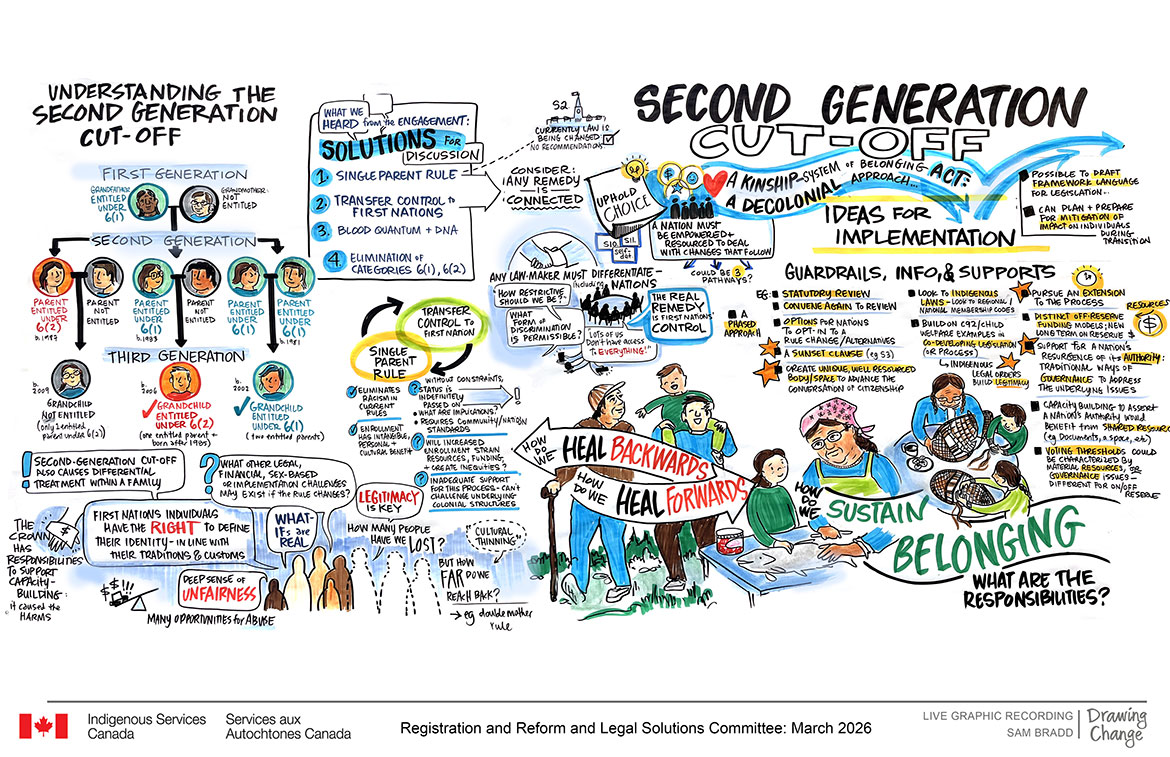
Text alternative for Second-Generation Cut-off
This hand-drawn visual graphic presents perspectives, considerations and solutions related to the second-generation cut-off. It is a non-linear graphic which utilizes illustrated figures, handwritten text, arrows, circular shapes, and dominant colours such as blues, violets, greens and yellows.
The image is divided into three primary sections:
- left
- right upper
- right lower
The left section of the image is predominantly violet, orange and green and focuses on introducing the second-generation cut-off issue. At the top is a family tree with three generations. Individuals entitled under 6(1) have a green bubble, individuals entitled under 6(2) have an orange bubble, while individuals non-entitled have a gray bubble.
The "First generation" has one grandfather entitled under section 6(1) of the Indian Act, and a non-entitled grandmother. The second-generation has three "parents":
- one to the right born in 1981 entitled under section 6(1) of the Indian Act who co-parents with an individual entitled under section 6(1) of the Indian Act and who have a child entitled under section 6(1) of the Indian Act ("Two entitled parents")
- one in the middle born in 1983 entitled under section 6(1) of the Indian Act who co-parents with a non-entitled individual and who have a child entitled under section 6(2) of the Indian Act ("One entitled parent [and] born after 1985")
- one on the left born in 1987 entitled under section 6(2) of the Indian Act who co-parents with a non-entitled individual and who have a child who is non-entitled ("Only [one] entitled parent under 6(2)")
A figure below shows many speech bubbles coming from a group of people, half of which are uncoloured and only include a dotted outline (to symbolize the people who have been "lost" due to the registration provisions. These bubbles include:
- "Second-generation cut-off also causes differential treatment within family"
- "First Nations individuals have the right to define their identity—in line with their traditions & customs"
- "Deep sense of unfairness"
- "What other legal, financial, sex-based or implementation challenges may exist if the [second-generation cut-off] rule changes?"
- "What-ifs are real"
- "Legitimacy is key."
To the left is an image of a hand with money inside it and the writing "The Crown has responsibilities to support capacity-building: it caused the harms." Below is an image of a scale out of balance, with the writing "Many opportunities for abuse." Above and to the right of the image of the group of people is written:
- "How many people have we lost?"
- "Cultural thinning"
- "But how far do we reach back? E.g. double mother rule."
The right upper section of the image is predominantly blue with some green and yellow accents and addresses the proposed solutions. A table at the top left noted "What we heard from the engagement: solutions for discussion", enumerating the solutions below: "1. Single parent rule", "2. Transfer of control to First Nations", "3. Blood quantum [and] DNA", and "4. Elimination of categories 6(1), 6(2) [of the Indian Act]."
Beside this is "Consider any remedy is connected" with reference to the solutions, while the single parent rule solution has an arrow pointing to an image of the Parliament of Canada saying "Currently law is being changed: no recommendations". Below are a green and yellow circles with arrows pointing to one another saying "Transfer control to First Nations" in one and "Single parent rule" in the other, noting these are intertwined. Below these circles is a check list which notes "Eliminates racism in current rules", "Enrollment has intangible personal [and] cultural benefit", and a question list which notes "Without constraints, status is indefinitely passed on" pointing to an exclamation point (!) to emphasize this point, below which states "What are the implications?" and "Requires community/[First Nations] standards."
Below these are additional questions, including "Will increased enrollment strain resources, funding [and] create inequities?" and "Inadequate support for this process—can't challenge underlying colonial structures." To the right side of this section is a blue banner which states "A kinship—system of belonging act: A decolonial approach" with arrows representing moving forward and a heart and depictions of a person, star and money over a group of people. To the left of the banner is a document on which is written "Uphold choice" with a light bulb, and a statement below "A [First Nation] must be empowered [and] resourced to deal with changes that follow" leading into three arrows pointing to "Could be [three] pathways?" Below the document is an image of a handshake in blue, with the title "Any lawmaker must differentiate—including [First Nations]", with an image of people sitting around a table and speech bubbles:
- "How restrictive should we be?"
- "What form of discrimination is permissible?"
- "The real remedy is First Nations' control"
- "Lots of us don't have access to everything!" with ‘everything' bolded in red for emphasis
The right lower section is primarily yellow and green, with blue and red intertwined, and is titled "Ideas for implementation [:] guardrails, [information] & supports." Examples are provided in a list which include:
- "Statutory review"
- "Convene again to review"
- "Options for First Nations to opt-into a rule change/alternatives"
- "A phased approach"
- "A sunset clause (e.g. 53)" (with an orange star beside for emphasis)
- "Create unique well-resourced body/space to advance the conversation of citizenship" (with an orange star beside for emphasis)
- "Look to Indigenous laws—look to regional/national membership codes", "Build on [Bill C-92]/child welfare examples in co-developing legislation (or process)"
- "Indigenous legal orders build legitimacy" (with an orange star beside for emphasis)
- "Pursue an extension to the process" (with an orange star beside for emphasis)
- "Distinct off-reserve funding models; new long-term on-reserve [funding]"
- "Support for a [First Nation's] resurgence of its authority: traditional ways of governance to address underlying issues"
- "Capacity building to assert a [First Nation's] authority would benefit from shared resources (e.g. documents, a space, etc.)"
- "Voting thresholds could be characterized by material resources, or governance issues—different for on/off reserve."
Below these examples is three images intertwined by arrows which state:
- "How do we heal backwards"
- "How do we heal forwards"
- "How do we sustain belonging"
- "What are the responsibilities?"
The left image is of a man walking with a cane beside another man with a child on his shoulders. The middle is of a child beside a woman who is about to cut a fish on a table. The right is of a woman and two children around the table handmaking traditional snowshoes.
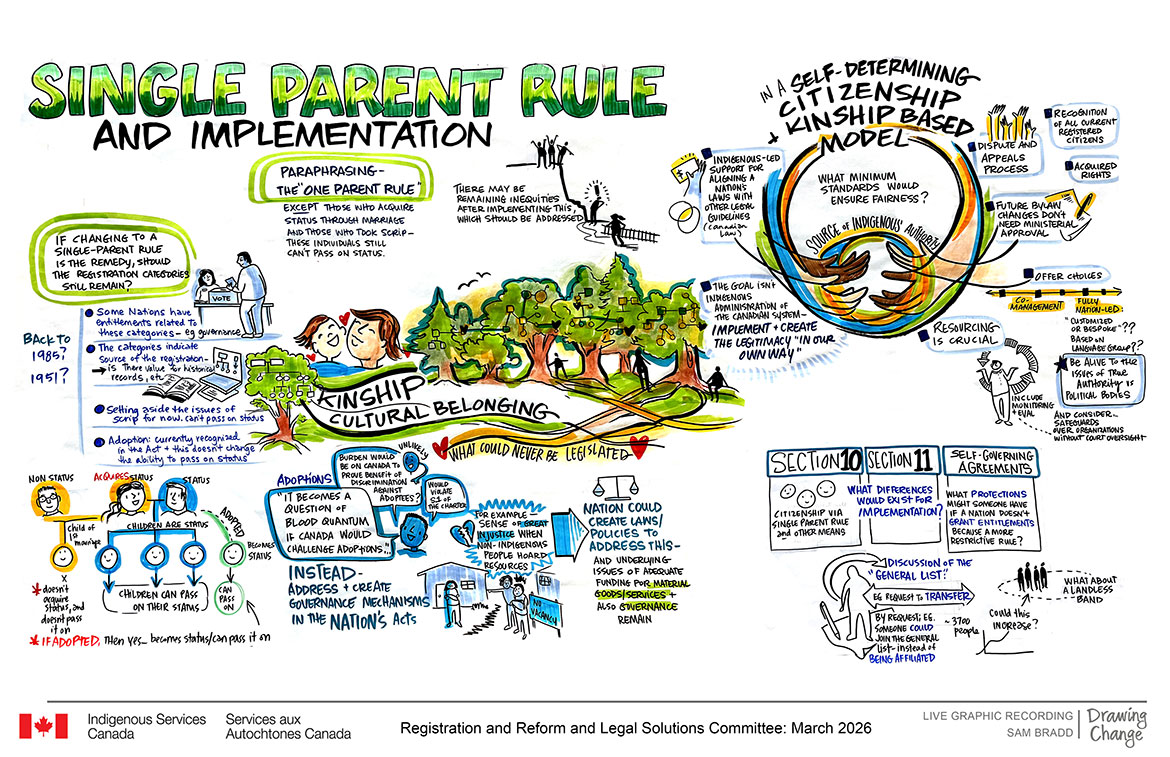
Text alternative for Single Parent Rule and Implementation
This hand-drawn visual graphic presents perspectives and considerations related to the implementation of the single parent rule for transmission of Indian status. It is a non-linear graphic which utilizes illustrated figures, handwritten text, arrows, circular shapes, and dominant colours such as greens, browns, oranges and blues.
The image is divided into four primary sections:
- left upper
- left lower
- right upper
- right lower
The left upper section of the image is predominantly green and brown. This section presents key considerations for the selection of the single parent rule as a solution to the second-generation cut-off. A green bubble wraps a question: "If changing to a single-parent rule is the remedy, should the registration categories still remain?" Below this is writing in blue showing a table coloured blue, on the left column is "Back to 1985? Back to 1951?" referencing the previous amendments to the Indian Act, while the rows in the right column show:
- "Some [First Nations] have entitlements related to these categories—e.g., governance" (beside which is an image of an individual casting a vote at a voting booth)
- "The categories indicate source of the registration—is there value for historical records, etc." (beside which is an image of books and documents showing family history trees)
- "Setting aside the issues of scrip for now. Can't pass on status."
- "Adoption: currently recognized in the act [and] this doesn't change the ability to pass on status."
Another green bubble wraps the words "Paraphrasing—the ‘one parent rule'", followed by "Except those who acquire status through marriage and those who took scrip—these individuals still cannot pass status" (with ‘except' underlined for emphasis), and to the right writing which states "There may be remaining inequities after implementing this, which should be addressed" encapsulated by a drawing to the right of this bubble depicting individuals at the top of the cliff cheering and pointing at individuals at the bottom of the cliff who are pulling a ladder. Lastly, there is a large image of a series of green and brown trees, in which there is family lineage charts connecting the trees (to mean family tree). A parent and child embrace one another with hearts around them, with the phrase "Kinship, cultural belonging, what could never be legislated" between the set of trees and hearts. Depictions of individuals are within these trees, sitting and standing.
In the left lower section, more technical information on the transmission of status is shared, with a family tree shown in which a status (blue) man and non-status (yellow) woman who acquired status from marriage to the status man have children, all of which are entitled and can transmit status. Another non-status (yellow) man is to the left of the woman and, presumably, was the first marital partner of the woman with which she had a child which is non-status regardless of her mother's recent acquisition of Indian status through her new marriage. Asterisks (*) specify that the mother "Doesn't acquire status, and doesn't pass it on" and "if [she were] adopted, then yes [she would] become status/can pass it on." Another child adopted by the status man is shown to acquire status and can pass it on.
Beside the family tree, three blue speech bubbles stemming from an individual coloured blue with the title "Adoptions" read "It becomes a question of blood quantum if Canada would challenge adoptions…", "Burden would be on Canada to prove benefit of discrimination against adoptees?" (with a blue individual stating "Unlikely"), and "Would violate [section] 1 of the Charter [of rights and freedoms]."
Below these bubbles reads "Instead—address [and] create governance mechanisms in the [First Nation's] acts", to the right of which is an image of individuals in front of a ‘no vacancy' sign crossed arms and pointing to another individual with crossed arms and a broken heart accompanied by "For example—sense of great injustice when non-Indigenous people hoard resources." An arrow points all of this to a balance scale (representing equity) and written "[First Nation] could create laws/policies to address this—and underlying issues of adequate funding for material goods/services [and] also governance remain", with ‘material goods/services" and "governance" highlighted in green for emphasis.
The right upper section is titled "In a self-determining citizenship [and] kinship based model", under which is a circular figure with four hands overlapping in the middle of the circle coloured orange, blue and green. In this circle is writing "What minimum standards would ensure fairness?" and "Source of Indigenous authority." Surrounding this circle are a number of blue rectangular bubbles which present important considerations for such a model of governance. The top left bubble states "Indigenous-led support for aligning a [First Nation's] laws with other legal guidelines (Canadian law)" with an image of a hand holding money and a Venn diagram. Below, the bubble states "The goal isn't Indigenous administration of the Canadian system—implement [and] create the legitimacy ‘in our own way'." The top right bubbles state:
- "Dispute and appeals process" (with hands risen)
- "Recognition of all current registered citizens"
- "Acquired rights"
- "Future bylaw changes don't need ministerial approval"
- "Offer choices" (which has a spectrum below ranging from ‘co-management' to ‘fully nation-led', with question below including "Customized or bespoke??" "Based on language group??")
The bottom left bubbles state "Resourcing is crucial" and "Be alive to their issues of true authority [versus] political bodies", to the left of which is an individual within circular arrows with hands up and confused (beside which is written "Include monitoring [evaluation]"), and linked to "And consider… safeguards over organizations without court oversight."
The right lower section has three rectangular bubbles for section 10, section 11 and self-governing agreements and is predominantly black and white. In the ‘Section 10' bubble is written "Citizenship via single parent rule and other means" with smiling faces drawn above. The ‘Section 11' bubble is written "What differences would exist for implementation?" which overlaps with the other two governance types. The ‘self-governing agreements' bubble is written "What protections might someone have if a nation doesn't grant entitlements because a more restrictive rule?" Below these bubbles is a drawing of a person on a paper with a pen with an arrow linking this to the writing "Discussion of the ‘general list'", below which is written "e.g. request to transfer" and "By request, e.g. someone could join the general list—instead of being affiliated" and the population on the general list written "~3700 people." To the right of this is a chart with an arrow increasing over time with the writing "Could this increase?" pointing to a group of people in a circle with the outside dotted and the writing "What about a landless band."
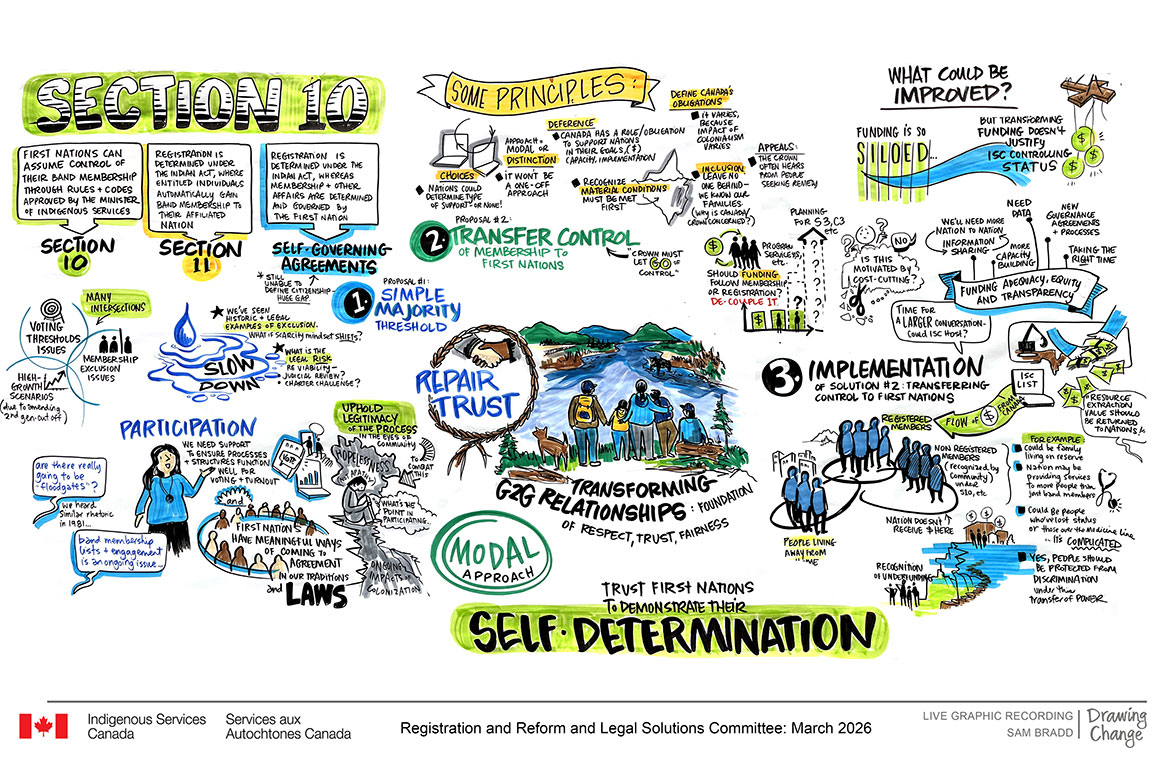
Text alternative for Section 10
This hand-drawn visual graphic presents ideas and themes related to broader reforms required for section 10 of the Indian Act and the double majority voting thresholds required to transition to membership self-governance under section 10. It is a non-linear graphic which utilizes illustrated figures, handwritten text, arrows, circular shapes, and dominant colours such as greens, blues and yellows.
The image is divided into three primary sections:
- left upper
- left lower/centre lower
- centre upper/right
The left upper section of the image is green, yellow and blue. At the top are three bubbles, each of which provides a description for each option for membership self-governance: section 10 (green), section 11 (yellow) and self-governing agreements (blue).
The section 10 bubble explains: "First Nations can assume control of their band membership through rules [and] codes approved by the Minister of Indigenous Services."
The section 11 bubble (yellow) explains: "Registration is determined under the Indian Act, where entitled individuals automatically gain band membership to their affiliated nation."
Lastly, the self-governing agreements bubble (blue) explains: "Registration is determined under the Indian Act, whereas membership [and] other affairs are determined and governed by the First Nation." There is an asterisk (*) and arrow pointing to the self-governing agreements bubble which states "Still unable to define citizenship—huge gap", with ‘huge gap' underlined for emphasis.
Below this are provided important considerations when discussing the issue of section 10 voting thresholds. First, the artist visually depicts the intersections between "voting thresholds issues" and "membership exclusion issues" and the "high growth scenarios (due to amending [second-generation] cut-off)". Second, the artist depicts a drop of water splashing with the words "slow down" intertwined in the puddle beside two key considerations, including: "We've seen historic [and] legal examples of exclusion. What if scarcity mindset shifts?" and "What is the legal risk re: viability judicial viability—judicial review? Charter challenge?" Within these, "Examples of exclusion" and "legal risk" are highlighted for emphasis.
The left lower/centre lower section of the image provides additional considerations under the subtitle "participation", with two speech bubbles referencing that "we heard similar rhetoric in 1981" which include "are there really going to be ‘floodgates'?" and "band membership lists [and] engagement is an ongoing issue." A person wearing blue and black is depicted saying: "We need support to ensure processes [and] structures function well for voting [and] turnout." Beside this bubble are visual depictions of a mobile phone with "vote" on the screen and a laptop with a chart, both representing online voting methods, while there is a third image showing two people talking representing in-person interactions, both of which are important to increase voter turnout. This leads into a group of people gathered together in a circle wrapping "First Nations have meaningful ways of coming to agreement (in our traditions and laws)", with ‘laws' bolded for emphasis. Beside this, a bubble states "Uphold legitimacy of the process in the eyes of community" with an arrow with writing "to combat this" pointing to an image of a man huddled and coloured gray with surrounding imagery showing gray clouds above and a gray crack in the ground noting "hopelessness (not apathy)" and "ongoing impacts of colonization" with "what's the point in participating…" in a thought bubble coming from the man, implying the surrounding factors are affecting their trust in the process. In centre lower, two people are shaking hands in a wreath with the writing "Repair trust", while below there is a green bubble where it states "Modal approach". Beside these is a landscape depicting two adults and three children and a dog looking out to a river with mountains in the distance. Below the landscape is written "Transforming G2G [Government to Government] relationships: Foundation of respect, trust [and] fairness." Below this is written "Trust First Nations to demonstrate their self-determination", with "self-determination" in bold and highlighted.
The centre upper/right section is denoted by a yellow banner on which is written "Some principles". Below this, "Choices" is written, with "Nations could determine type of support—or none!" underneath. Above this point, two laptops are side by side with a circular arrow connecting the two. Beside this is written "Approach [is] modal or distinction", below which is written "It won't be a one-off approach." Beside this is written "Deference", under which is written "Canada has a role/obligation to support [First] Nations in their goals, [funding], capacity [and] implementation" and "Recognize material conditions must be met first" with an arrow pointing to the portion of an image of an iceberg which is below the water line. Beside this is written "Define Canada's obligations" over "It varies because impact of colonialism varies" over "Inclusion", below which is written "Leave no one behind—we know our families (why is Canada/Crown concerned?)." Beside this is a final core principle "Appeals", under which is written "The Crown often hears from people seeking remedy."
Below all these principles is an overview of solutions discussed. Beside a bubble with the number one ("1") and written in blue is "Proposal #1: Simple Majority Threshold". Beside a bubble with the number two ("2") and written in green is "Transfer control of membership to First Nations", with an arrow pointing to this solution linking to writing "Crown must let go of control", with emphasis on "go". Beside a bubble with the number three ("3") and written in black is "Implementation of solution #2: Transferring control to First Nations", from which there is a speech bubble which states: "Time for a larger conversation—could [Indigenous Services Canada] host?"
At the top of the right section is written "What could be improved?" Below is written "Funding is so siloed…" with "siloed" separated into green silos. Beside is a wave flowing from the siloes as a more natural approach to funding, on which is written "But transforming funding doesn't justify [Indigenous Services Canada] controlling status" beside a puppet handle dangling coins by a string. Under this is a banner which states "Funding adequacy, equity and transparency", from which stems:
- "We'll need more nation to nation information sharing" in circular arrows, "More capacity building"
- "Need data"
- "New governance agreements [and] processes"
- "Taking the right time."
Beside this is an image depicting a thought bubble stating "Is this motivated by cost-cutting" being cut by scissors with a person with raised hands looking inquisitive surrounded by question marks (?), with another speech bubble that states "No". To the left of this is a bar chart, with a dollar sign and coloured green with the two right most bars being filled primarily with question marks (?) which increase over time, with writing above "Program services, etc." and "Planning for [S-3], [C-3], etc." denoting uncertainties in estimated program costs as a result of previous and ongoing Indian Act amendments. Beside this is a drawing of a coin with circular arrows pointing to a group of people, below written "Should funding follow membership or registration? De-couple it." With ‘de-couple it' in red for emphasis.
To the right of the ‘Implementation' point is an image of an excavator digging ground and hands exchanging large amounts of money, below which shows a speech bubble "Resource extraction value should be returned to nations!" To the left of this is a laptop with "ISC list" written on this, and a large green arrow (on which is written "Flow of [money] from Canada") pointing to an image of people labelled as "Registered members" with a ring surrounding them overlapping with rings from other groups of people, one of which is labelled "People living away from home" and the other "Non-registered members (recognized by community under [section] 10, etc.)." Examples of members of this group include:
- "Could be family living on reserve"
- "[First Nation] may be providing services to more people than just band members"
- "Could be people who've lost status or those over the medicine line… It's complicated" with "It's complicated" underlined for emphasis,
- "Yes people should be protected from discrimination under this transfer of power"
Beside this is a hillside pathway with "recognition of underfunding" written above group of people at the bottom of the hill, and a group of people in front of houses with coins above them at the top of the hill, with both groups divided by the colours green and blue. The group "Non-registered members" also has an arrow pointing to them with writing "Nation doesn't receive [money] here."

Text alternative for Broader Reforms
This hand-drawn visual graphic presents ideas and themes related to broader reforms related to registration, citizenship, membership, and both individual and collective rights and identity. It is a non-linear graphic which utilizes illustrated figures, handwritten text, arrows, circular shapes, and dominant colours such as blues, greens and yellows.
The image is divided into four primary sections:
- left
- centre upper
- centre lower
- right
The left section of the image is predominantly blue and features an image of five individuals seated around the table. The question at the top of this section is: "What will restore nationhood?" Speech bubbles indicating responses from those around the table include:
- "Data access and control must go with capacity of communities to steward it"; "nations as the source of authority"
- "data protection (e.g. confidentiality)"
- "registration by the state (e.g. lists, cards, etc.) enables the state to uphold its responsibilities to Indigenous peoples."
Below this, an image of a person and multiple figures behind them expand upon the state's responsibilities to Indigenous peoples with a note highlighted in yellow which reads "Identities of First Nations Peoples are not, [and] should not, be determined in that way" making reference to state-led registration. The labels of "citizenship" and "kinship" surround the figures in this image, which emphasizes the importance of relationships and community-driven belonging.
The centre section features three overlapping circles, each asking a different question:
- "How to transfer authority?"
- "What info would flow in and alignment to UNDRIP, etc.?"
- "Should there be a central registry? Will it advance First Nations citizenship?"
Accompanied by two separate overlapping circles, an additional fourth questions asks "What is missing?" Here, a drawing of a graph with the label "ISC" includes the note that "Records are Nation's intellectual property: It's collectively held (e.g. birth, death, records/documents." There is a note which reads "Federal law + privacy laws will need to change" and that "a deep foundation of trust in each others ways [is needed]."
There is note of tension between individual rights (and a Western model) and collective, intellectual property rights (and Nation-specific/Indigenous law) when it comes to determining belonging.
The centre bottom expands upon this tension and shows an image with a person and documents with "privacy" in quotations for emphasis, with the note that "If proof or records are shared with the Crown (individual privacy rights/interests… these records should be shared with the Nation, if the Nation is managing the registration." This ties "privacy" rights with the right "to be known", "who you are", and "protected" collectively.
Along the right section of the image is a vertical flame shaped graphic. At the top, is a blue-green circle with the label "Self-determining & thriving First Nations and people." Below this notes that:
- "Implementation will require deep, technical coordination + resourcing"
- "Crown commits to a new, kinship + belonging act – not just an extension; not just reforms"
- "Look at C-92 + coordination agreement as sources"
Below this is the label "Moving beyond the Indian Act" with text that reads "To leave no one behind" and "come together again with strong voices." Below this, a graphic of three people walking with a speech bubble that reads "Determining citizenship ‘is a jumping-off point'" which will require "open, ongoing [and] honest dialogues."
Beside this is a hillside pathway with "recognition of underfunding" written above group of people at the bottom of the hill, and a group of people in front of houses with coins above them at the top of the hill, with both groups divided by the colours green and blue. The group "Non-registered members" also has an arrow pointing to them with writing "Nation doesn't receive [money] here."
Beside the flame is a blue curved line upon which text is overlayed which reads "Respecting First Nations' authority over membership, governance + services" while text on top of the flame includes the words "Authority", "protocols", "language", "land" and "Indigenous laws in practice".
Defining legal viability
Committee members were asked to articulate their understanding of legal viability and how it informed their analysis. This included consideration of whether proposed solutions could be implemented within Canada's existing legal framework while respecting constitutional obligations, including section 35 of the Constitution Act; sections 7, 15, 25, and 28 of the Canadian Charter of Rights and Freedoms; and Canada's commitments under the UN Declaration.Footnote 3
While constitutional and statutory alignment remain important in determining legal viability, reports also emphasized that a solution is legally viable only if it is also legitimate, implementable, and consistent with Indigenous legal orders (ILOs) and self-determination.Footnote 4 Members shared perspectives regarding the diversity of ILOs, and the need to ensure alignment with Indigenous legal traditions, many of which are distinct to specific communities' legal orders but include principles such legitimacy, transparency, reciprocity, deliberation, and love.Footnote 5 Normative coherence to these underlying principles, and thus Indigenous law in general, must not be taken as an abstract obligation a solution must fulfill, but rather as a need to ensure the solution is appropriately "embedded in stories, practices, and teaches that provide continuity over time."Footnote 6
The constraints and protections that the Charter extends were also explored. For example, while section 25 protects the exercising of Indigenous rights and self-government from being undermined by individual charter claims, the guarantee of sex equality under section 28 and the Constitution's section 35(4) supersedes this.Footnote 7 Conversely, in Dickson, the Supreme Court held that while Charter provisions apply to Indigenous governments and laws, "[w]here a challenged rule reflects Indigenous self-government or Indigenous legal traditions, section 25 may operate to bar a Charter claim."Footnote 7 Reports cautioned against the risk that though solutions may be legally viable, their weakness my lie in their inconsistency with First Nations self-determination.Footnote 8
Notably, consideration of domestic law alongside international law and Indigenous legal orders (ILOs) was a primary concern for many members. In her final report, Dr. Sarah Morales (Su-taxwiye) wrote that international law is "a body of law that increasingly shapes and constrains how Canada understands its own legal obligations" and that the UN Declaration's affirmation that Indigenous peoples have the right to self-determination – as well as distinct political, legal, economic, social, and cultural rights – "reflects an emerging consensus within international law that Indigenous legal orders are not subordinate systems but constitute independents sources of legal authority."Footnote 9 Morales wrote that international or domestic law should not be taken to displace ILOs, but rather "should be understood as one strand in a braided approach, where each legal system maintains its own integrity while interacting with others."Footnote 10
The need to consider legal viability beyond satisfaction of obligations set out by international law, or adherence to responsibilities defined in domestic legislation was argued for by most members, including Hon. Lillian Dyck, who wrote that First Nations' spiritual and cultural traditions ought to be considered on equal footing,Footnote 11 and Regional Chief Marsha Smoke and Crystal Stevens, writing on behalf of the Anishinabek Nation, who wrote that whether a solution could survive a constitutional challenge is one thing, but it could still be legally weak if it is inconsistent with self-determination objectives.Footnote 12
Solutions to the second-generation cut-off
Solution 1: Single-Parent Rule
Solution description
Determination of entitlement would depend on individuals having at least one parent who is, or at the time of their death was, entitled to registration indefinitely, unless otherwise specified.
Legal viability
A large majority of members considered the approach legally viable, although views differed regarding whether it should operate as a permanent solution or as an interim measure pending the development of First Nations-led citizenship frameworks.
Responses from First Nations-led Options for Solutions
The single-parent rule was frequently proposed by First Nations and representative organizations, appearing in 26 of the 39 final reports submitted to date. Similarly, 305 of the 399 Individual Feedback Form respondents selected it as a desirable solution.
RRLSC analysis
Perceptions of a single-parent rule's viability were mixed across members, with most deeming it viable insofar as constraints were in place to prevent it from being a permanent, enduring framework for determining entitlement.
In their reports, the Anishinabek Nation and Morales observed that, in practice, entitlement already functions similarly to a single-parent model, as eligibility depends on one entitled parent while limitations apply to the second parent. They noted that the proposed approach would formalize this structure while removing restrictions related to the second parent.Footnote 13 The Anishinabek Nation's report further noted that this solution would continue the federal role in defining entitlement while limiting the ability of First Nations to rightfully exercise jurisdiction over citizenship and belonging.Footnote 14 As such, Drew Lafond, writing on behalf of the Indigenous Bar Association (IBA), and the Anishinabek Nation share the view that the single parent rule is "acceptable as an immediate measure… but… not a complete or standalone solution" and its viability "is expressly contingent on the development of a clear, consent-based, opt-out framework through which First Nations may assume jurisdiction over citizenship and belonging."Footnote 15
Dyck raised concerns that a single-parent rule, "even though well-meaning and with good intentions, does not recognize the rights of First Nations to choose how they themselves wish to solve the problem."Footnote 16 Dyck further noted that implementation without obtaining free, prior, and informed consent (FPIC) could be inconsistent with Canada's obligations under the UN Declaration. Dyck indicated that, where FPIC is obtained, First Nations should have the ability to opt in to the approach.Footnote 11
Participants also expressed varying views relating to the single-parent rule's accordance with the UN Declaration. Dr. Aaron Mills indicated that the single-parent rule does a better job than the second-generation cut-off at respecting the UN Declaration Articles 1 and 2, while Dr. Damien Lee noted that it appeared consistent with Articles 5, 8.1, 8.2, 9, 22.2, 33.1, 34, 35 and 37.Footnote 17 Despite differing perspectives, members were united in their cautioning against imposing this solution on communities without FPIC.
Implementation considerations
Participants identified a number of implementation considerations associated with the proposed approach. Reports noted that implementation could create operational pressures requiring additional funding and capacity supports for First Nations, as well as clear mechanisms to address differences between federal registration and First Nations membership or citizenship determination processes.
Members also expressed differing views regarding whether this approach should apply indefinitely. Some members supported permanent implementation, while others emphasized that First Nations hold distinct legal traditions and approaches to belonging that may not align with a permanent federally defined model.Footnote 18 For example, it was noted that Anishinaabe law does not endorse the view that racial thinning occurs over time and rather than conceptualizing identity in respect of racial or ethnic purity, "its measure of belonging consists in one's practice of kinship responsibility."Footnote 19
The IBA's report identified the risk and vulnerability of First Nations whose administrative capacity is not suited to serve the eligible population this solution would create.Footnote 20 National Chief Brendan Moore and Robert Russell, writing as representatives of the Congress of Aboriginal Peoples (CAP), proposed a mitigation measure in their report, involving automatic implementation, whereby all individuals currently registered under subsection 6(2) would be converted to subsection 6(1) without requiring individual applications.Footnote 21 Members noted that such an approach could reduce administrative burden and processing pressures. However, they also emphasized that implementation would require coordination with First Nations and individuals, including the potential for opt-out mechanisms where there is opposition to the approach.
Members further noted that implementation of the single-parent rule without corresponding amendments to section 10 voting thresholds could create concerns for First Nations seeking to assume control over membership. In particular, the IBA noted that maintaining existing voting thresholds while expanding the registered population "may be perceived as undermining [First Nation's] governance legitimacy rather than simply expanding inclusion."Footnote 20
Members also emphasized the importance of ensuring that implementation does not perpetuate federally imposed definitions of identity and belonging. Reports highlighted the need to recognize the impacts of past legislative approaches that regulated Indigeneity through gendered, racialized, and heteronormative frameworks. In an attempt to manage a perceived "floodgates" narrative, both the IBA and Lee cautioned against reintroducing arbitrary exclusion and recreating discrimination through the reimplementation of "ancestry thresholds, arbitrary cut-off dates, or partial retroactivity."Footnote 22
It is therefore important that any solution to the second-generation cut-off does not take the form of a permanent federal role, and is instead a temporary means to address inequity while providing time for First Nations to develop and implement their own, First Nation-led citizenship framework. Several members, including the IBA, Anishinabek Nation, and Dyck, emphasized that a single-parent rule maintains the status quo wherein control remains in federal hands and is insufficient given it does not recognize the rights of First Nations to choose and implement a solution for themselves.Footnote 23 IBA specifically flagged that should Canada remains the unilateral decision-maker over Indigenous citizenship, a single-parent rule, by itself, does not resolve concerns with Section 35 of the Constitution.Footnote 24 It should only be considered as a transitional measure, and paired with a "clear, consent-based, opt-out framework through which First Nations assume exclusive authority over citizenship."Footnote 20
While a single-parent rule may be introduced in tandem with an opt-out clause for First Nations in one legislative package, this may reduce future system re-work but require "extensive up-front policy design, consultation, systems development, and intergovernmental coordination [and f]rom an operational perspective… would likely delay access to relief for affected."Footnote 25 Alternatively, immediate implementation of a single-parent rule accompanied by a statutory commitment and defined timeline for the introduction of a First Nations citizenship framework prioritizes timely relief for those currently affect, though may result in operational risks.Footnote 25
Ultimately, consistent in all members' reports was that "transition management [is] central to successful implementation," and a resolution to the second-generation cut-off cannot be achieved expediently.Footnote 26 Rather, it will take time, care, and commitment by the government to acknowledge past harms and avoid their duplication, whilst extending First Nations the ability to exercise their authority and jurisdiction over belonging.
Solution 2: Transfer control to First Nations
Solution description
Entitlement would be under the jurisdiction of First Nations, and they would have the authority to develop criteria, evaluate applications, render a decision, and submit the decision to the Department for information purposes.
Legal viability
Six out of seven members identified this solution as legally viable, with two noting that viability will be contingent on implementation considerations. One participant considered the approach not legally viable.
Responses from First Nations-led options for solutions
Transferring control to First Nations was identified in 19 of the 39 final reports and 160 of the 399 Individual Feedback Form respondents selected it as a desirable solution.
RRLSC analysis
Broadly, an approach to transfer control of registration processes under the Indian Act to First Nations has been deemed legally viable under Canadian law and international human-rights frameworks, with conditions.Footnote 27 It was repeatedly noted that this particular solution was one of or the most aligned with domestic and international human rights frameworks, including the Charter of Rights and Freedoms, the UN Declaration, and the UN Declaration Act.Footnote 28
Participants expressed differing views regarding the extent to which federal oversight or intervention may continue to be required during implementation or transition. Some emphasized that ongoing federal involvement may be necessary to limit discrimination and support alignment with the UN Declaration, while others cautioned that excessive federal oversight could undermine First Nations self-determination and perpetuate colonial structures.Footnote 29 Reports also noted that this approach may better align with Indigenous legal orders, which may conceptualize citizenship through relationships, responsibilities, kinship, and belonging rather than solely through legislative criteria. At the same time, Lee, Morales, and Mills cautioned that First Nations themselves may adopt rigid or exclusionary definitions of citizenship that could potentially conflict with principles contained in the UN Declaration.Footnote 30
Implementation considerations
Participants emphasized that, for the approach to be legally viable, implementation would need to be carefully designed and structured. Reports identified several key considerations, including that implementation should:
- Provide First Nations with the full unconditional authority over identifying methods to determine who their people are and how to implement these methodsFootnote 11
- Respect both the collective right of First Nations to self-determination and the rights of individual First Nation persons who may not be recognized as members by a band councilFootnote 31
- Be well-structuredFootnote 32, respectful of the rights and needs of First Nations (including FPIC)Footnote 33 and provide meaningful support and resources to build the capacity of First Nations to take control of registration processesFootnote 34
- Recognize that citizenship and belonging under Indigenous legal orders are connected to identity, kinship, and governance, rather than solely administrative policy questionsFootnote 35
- Limit the risks of discrimination, including discrimination affecting off-reserve membersFootnote 36
- Ensure that Canada retains its fiscal responsibilities and liabilities associated with registrationFootnote 34
- Relocate decision-making authority to First Nations (not just delegated), and implement procedural safeguards and independent Indigenous review capacityFootnote 37
- Provide First Nations with capacity to develop and administer their own citizenship or membership laws (including eligibility criteria, registry management, and dispute-resolution processes)Footnote 38
The Anishinabek Nation and Morales' reports emphasized that sustained, long-term funding responsive to population growth and demographic changes would be necessary to support implementation.Footnote 39 Participants also encouraged phased and incremental implementation approaches to ensure large-scale changes are implemented properly and in a manner that respects First Nations timelinesFootnote 40, governance structures, and existing treaty relationships.Footnote 41
Reports further emphasized that participation in the transition process must remain optional in order to respect First Nations self-determination.Footnote 41 Regardless of the implementation model adopted, members stressed that Indigenous legal orders and Indigenous dispute resolution processes should play a central role in addressing conflicts and disputes in order to reduce reliance on colonial legal frameworks.Footnote 42
At the same time, members cautioned that some First Nations may adopt rigid conceptions of citizenship that may not align with relational understandings of belonging reflected in certain Indigenous worldviews.Footnote 43 Participants noted that this possibility may require additional safeguards, representation mechanisms, or oversight considerations to ensure consistency with the UN Declaration and broader human rights principles.Footnote 43
The First Nations-led approach to First Nations Child and Family Services in An Act respecting First Nations, Inuit and Métis Children, youth and families (formerly Bill C-92) was often discussed as a successful model to guide implementation on this issue, at the core allowing the unique customs of each First Nation to be central with the delivery of services for individuals from this First Nation.Footnote 44 Should a solution to the second-generation cut-off be introduced in a legislative package modelled after Bill C-92, clarity on notice; coordination with provincial and federal governments; fiscal support; and conflict-of-laws rules during a transition period would be critical to ensuring successful transition and implementation.Footnote 45
Participants also discussed a potential spectrum of ongoing federal involvement following implementation. For example, Canada could continue to maintain central registration databases or data storage systems while supporting First Nations in preparing for and administering the transition.Footnote 41
Some members further proposed the establishment of regional organizations operating at arm's length from the federal government. Under this model, such organizations could support oversight, coordination, or dispute resolution related to citizenship or membership codes, while providing finalized citizenship or membership information to the federal government for registration purposes.Footnote 46
Solution 3: Use of blood quantum and DNA
Solution description
Blood quantum is a system used primarily in the United States to define Indigenous identity based on the proportion of Indigenous ancestry attributed to an individual. The use of DNA involves establishing criteria for determining Indigenous identity based on biological or genealogical evidence and family history.
Legal viability
Two members indicated that the approach may be viable only where it is adopted by First Nations as an exercise of self-determination and grounded in Indigenous legal traditions or governance systems. Five of seven members identified this solution as not legally viable on a national basis.
Responses from First Nations-led options for solutions
The use of blood quantum or DNA were proposed in two of the 39 final reports submitted by partners, with 34 of 399 Individual Feedback Form respondents proposing blood quantum and 53 of 399 respondents suggesting the use of DNA. Across all contexts, these solutions were raised cautiously and not necessarily the preferred or endorsed solution by individuals or the community.
RRLSC analysis
Perceptions of the use of blood quantum and DNA to determine entitlement to registration and membership were largely critical across committee members, with five members stating it is not viable. Dyck and Morales both noted that these approaches may be considered viable insofar as they are adopted by First Nations as an exercise of self-determination and grounded in their own legal traditions or contemporary practices.Footnote 47 However, Morales and Mills emphasized that blood quantum remains a colonial construct that operates through biologically reductive measures and does not reflect relational understandings of belonging, especially under Anishinaabe Law.Footnote 48
Across many Indigenous legal traditions, belonging is "grounded in kinship, relationships, and responsibilities" and should be "lived and practiced, not measured".Footnote 49 The use of biological determinations are in direct opposition to this worldview as it reduces identity to a fractional calculation and is "anti-relational."Footnote 50 These solutions were characterized as reproducing exclusionary or assimilationist structures embedded in colonial legislation.Footnote 51
Participants emphasized that the use of blood quantum and DNA to determine entitlement raises significant concerns in relation to Canada's constitutional and human rights frameworks. Mills noted that biological determinants of identity engage enumerated grounds of discrimination under section 15 of the Canadian Charter of Rights and Freedoms and are therefore unlikely to be legally viable as standalone criteria.Footnote 52 Both the IBA and Anishinabek Nation noted that blood quantum and DNA-based approaches:
- are fundamentally incompatible with human rights based frameworks
- would likely increase, rather than mitigate, litigation exposure
- would deepen, not solve, exclusion.Footnote 53
Morales echoes this concern, writing that "while UNDRIP may protect the use of these methods" specifically in scenarios where First Nations elect to implement them as an exercise of self-determination, doing so may "simultaneously reproduce settler colonialism."Footnote 54 In practice, if implemented by the federal government without the FPIC of First Nations, this solution would be incompatible with the Indigenous right to self-government and self-determination, and as an "external, colonial imposition" would drive disputes into colonial human-rights based forums without any pathway towards resolution in a manner consistent with Indigenous self-determination or substantive equality.Footnote 55
Participants also identified these approaches as potentially inconsistent with several articles of the UN Declaration, particularly Articles 8 and 9, which protect against forced assimilation and affirm the right to belong without discrimination, as well as Articles 33 and 35, which recognize Indigenous authority over identity and membership.Footnote 56
However, Dyck noted that these approaches may be capable of alignment with constitutional and international human rights frameworks where they are adopted through First Nations' "customary or contemporary practices" as an exercise of self-government under section 35 of the Constitution Act, 1982.Footnote 11 Similarly, Morales and Lee indicated that viability under the UN Declaration may be understood differently in cases where blood quantum is chosen by a First Nation but its substantial viability remains questionable when considered alongside Articles that promote non-discrimination and alignment with Indigenous legal systems.Footnote 57
Implementation considerations
Reports by the CAP and the IBA emphasized that the implementation of any solution which uses biological determination would result in significant legal and financial burdens due to the infringement of the Charter and the UN Declaration, while also requiring complex evidentiary processes such as genealogical reconstruction and genetic testing.Footnote 58 Furthermore, the Anishinabek Nation noted that while DNA was capable of confirming biological relationships, it does not function to determine belonging, community connection, or recognition in accordance with Indigenous legal systems.Footnote 59
The use of DNA was therefore primarily encouraged as a supplementary evidentiary tool in parentage cases, not as a standalone solution. As a tool in this instance, Lee suggested that DNA could support efforts to reconnect individuals who were displaced through adoption or child welfare interventions, including the Sixties Scoop and related practices.Footnote 60
The successful utility of both blood quantum and DNA lies primarily in confirming parentage, and that application beyond this limited scope risks reinforcing heteropatriarchal norms and contributing to long-term legislative exclusion.Footnote 61 There is also the potential for demographic decline over time in the context of intermarriage due to the limitations being imposed.Footnote 49 Participants raised that if a membership framework uses biological determinants, it must reflect diverse kinship systems, including those that recognize adoption, marriage, and Two-Spirit and queer family-making practices.Footnote 62
Overall, blood quantum and DNA-based frameworks were described as embedding exclusion and discrimination within the rule itself. The IBA's report highlighted that instead of "remedying historic injustices, blood-quantum and DNA-based approaches entrench and intensify them."Footnote 63 In return, these approaches will "accelerate intergenerational loss of recognition, disproportionately harm descendants already affected by historic sex-based discrimination and perpetuate federal control over Indigenous identity."Footnote 63
Solution 4: Elimination of registration categories altogether
Solution description
The elimination of the registration categories in section 6 of the Indian Act would remove distinctions-based categories within the federal registration regime, resulting in individuals either being registered or not registered. While this approach does not specify the criteria by which entitlement decisions would be made,Footnote 64 it reflects a broader interest in establishing a more straightforward and less technical registration process.
Legal viability
Five of seven members identified this solution as legally viable, with some noting additional information required. Two members chose to abstain from this analysis.
Responses from First Nations-led options for solutions
This solution was proposed in 2 of the 39 final reports received in the Development of Solutions, but was included as an implementation consideration in 13 reports discussing the single-parent rule, and 1 report discussing the transfer of control to First Nations. This solution was proposed in 115 of the 399 Individual Feedback Form submissions.
RRLSC analysis
Participants noted that the current registration categories in section 6 of the Indian Act create a hierarchical structure with exclusionary impacts.Footnote 65 The elimination of the registration categories would address the inequities created by the existing system, of which has been developed to serve Canada rather than First Nations.Footnote 65 Morales deemed this solution "necessary if Canadian law is to move toward a more coherent recognition of Indigenous peoples and their legal orders."Footnote 66
In many traditions, belonging is not determined through categories, but rather through relationships with family, land, community, and the obligations that emerge from these relationships.Footnote 66 Although this solution is considered legally viable, several reports including the IBA's emphasized that it is not "suitable as a standalone immediate reform" since entitlement itself is not defined in this approach nor does it displace Canada's role as the decision-maker over First Nations' belonging.Footnote 67 Given its lack of specificity, additional details are required to fully determine its legal viability.Footnote 68
Participants also noted that the elimination of registration categories may align with several articles of the UN Declaration, particularly as it reduces discrimination within the federal registration regime.Footnote 69 Dyck noted that free, prior, and informed consent must first be obtained by First Nations if this solution is to potentially align with UNDRIP.Footnote 70 The IBA added that this solution is only aligned with UNDRIP as long as it is paired with Indigenous authority over citizenship.Footnote 71 If Canada remained as the "arbiter of belonging," it would simply be a re-branded federal identity system rather than a transition to self-determination.Footnote 71
Participants observed that the approach may align with Articles 8 and 9 regarding the protection of Indigenous peoples from discriminatory identity classifications and assimilation,Footnote 72 with arguments that this solution would increase individuals' ability to obtain status if they choose, therefore encouraging self-determination and the right to culture.Footnote 73 Lee further noted that this solution also resonates with Articles 22 and 33, by supporting Indigenous nations in using their own kinship systems to support belonging, particularly for women and children who have been previously excluded.Footnote 74 With Article 32, this solution supports First Nations to promote, develop, and maintain their citizenship structures.Footnote 74 Where treaties exist, the state should defer to the citizenship order of the respective treaty partner, reflective of Article 37 of the UN Declaration.Footnote 74
Overall, members – including Morales – generally agreed that removing the section 6 framework would be "consistent with [the UN Declaration]'s emphasis on continuity, non-discrimination, and the restoration of Indigenous authority over belonging."Footnote 75 However, members also emphasized that the approach must be accompanied by recognition of First Nations jurisdiction over citizenship, as well as adequate supports and resources.Footnote 76
Implementation considerations
Members generally agreed that the elimination of registration categories could function as an interim measure while Canada and First Nations continue broader discussions regarding self-determination and citizenship.Footnote 77 The current registration categories are technical and complex, placing members of the same family in different categories.Footnote 78 Participants further observed that eliminating the categories could create an opportunity for Canada and First Nations to reconsider both entitlement criteria and registration processes more broadly.Footnote 79 Reports emphasized that any revised registration process should be simplified and accessible, particularly for individuals who were previously excluded from registration or denied status.Footnote 80 Considerations also need to be made for changes to be clearly communicated to First Nations and impacted individuals, including individuals living off-reserve.Footnote 81
Lee proposed the establishment of a citizenship commission a possible implementation model.Footnote 79 Under this approach, "First Nations appoint representatives to regional commissions where citizenship or membership lists are determined and maintained."Footnote 82 These commissions may also be responsible for reviewing complaints or appeals.Footnote 82 This approach presents a possible pathway forward for both membership and for a shift in the role of the Indian Registrar.
This solution also requires significant administrative changes, including updates to the Indian Registry, program eligibility alignment, and transitional measures to prevent service loss.Footnote 83 Risks to procedural fairness arise if individuals who are impacted do not have clear criteria or review mechanisms, especially during transition periods where federal recognition and First Nation citizenship do not align.Footnote 71 Given the potential for increased population growth and broader eligibility, reports consistently emphasized the need for adequate long-term funding and resources to support housing, health services, education, infrastructure, and community programs.Footnote 84 Participants further noted that insufficient resourcing could risk perpetuating existing inequities.Footnote 84
Participants identified implementation design as the primary concern associated with this approach and cautioned against proceeding without a clearly articulated path forward.Footnote 66 As evidenced by the White Paper conflict, Mills wrote that it would be a "serious error to try to remove the Indian Act without a clearly-articulated and viable alternative means of recognizing Indigenous difference."Footnote 85 Similarly, when proposing the removal of the Indian Act's registration categories without a clear alternative, this risks recreating the same circumstances.Footnote 86 Eliminating the registration categories and it's hierarchy is seen as an improvement to the registration process, but the solution must be accompanied by a clear implementation plan to be effective.
Solutions to the Section 10 voting thresholds
Solution 1: Simple majority vote
Solution description
Replace the double majority requirement for the consent vote with a simple majority requirement. This can be accomplished by repealing section 10(2) of the Indian Act.
Legal viability
One participant identified this solution as viable, with four deeming it non-viable. Two members did not provide an assessment of its viability.
Responses from First Nations-led options for solutions
Seven of 21 final reports proposed that consent should be achieved through a simple majority vote.Footnote 87 Of individual feedback responses, 44 of the 399 respondents selected a simple majority vote as a preferred solution making it most popular solution given 198 of the 399 respondents selected that they were "unsure" of a solution to the issue.
RRLSC analysis
Most members considered the simple majority approach not legally viable as a standalone reform. Participants noted that the approach does not address many of the substantive concerns associated with the current double-majority framework, including concerns that federally imposed voting thresholds may not reflect ILO's, governance traditions, or culturally grounded approaches to collective decision-making.Footnote 88 Absent these considerations as Dyck noted, there may be situations wherein an individual First Nation finds a simple majority vote is a favorable method for achieving consent to transition consistent with its guiding cultural and legal norms, and does freely, and with prior and informed consent, agree to employ a simple majority vote.Footnote 70
Members noted that views on appropriate and legitimate voting methods will vary from nation-to-nation, dependent on that community's ILO.Footnote 89 On its own, a simple majority voting threshold is not inherently unlawful, though its legitimacy is contingent on alignment with broader principles of Indigenous self-determination, collective consent, and procedural fairness.Footnote 90 Members acknowledge the reduced burden it would require Nations meet, and that it is consistent with ordinary democratic practice – however, given the serious nature of Section 10 membership decisions, argue that the threshold alone cannot be what grounds the process.Footnote 91
A simple majority vote may support self-determination, if it is reflective of a Nation's own governance processes, making it consistent with Articles 3, 4, 5 and 33 in the UN Declaration.Footnote 92 However, it risks preserving a colonial framework for determining consent and simply replacing one externally-imposed voting rule for another as it does not create space of Indigenous-defined decision-making processes consistent with the UN Declaration.Footnote 93 In his report, Lee noted that "Indigenous political orders do change over time; simple majority voting may just be what a band sees as their tradition now. Assessing congruency with any Article should be careful to not freeze Indigenous political traditions in time."Footnote 94 If however, with a simple majority vote – in a community where only a small proportion of the population actually participates – members shared concerns that the outcome may not meet the standards of meaningful participation, FPIC, and non-discrimination set out in Articles 9, 18, and 19.Footnote 95
Section 10 votes result in changes affecting the community and who constitutes its membership and therefore demand a higher threshold of broad and inclusive consent, as demonstrated by the double-majority voting thresholds.Footnote 96 Concerns that a simple majority will enact these changes on the basis of narrow, or minimal, participation and small margins risk the fairness, legitimacy, and exclusion of members who, for varying reasons, were unable to participate in the vote.Footnote 97 ILOs do not derive legitimacy of an outcome from prescribed numerical thresholds alone, instead requiring that decisions are grounded in relationships, responsibilities, and collective deliberation and decision-making processes; a simple majority vote must be complemented by a commitment to these principles.Footnote 98
Implementation considerations
Legislative change at the federal level, coupled with substantial procedural and capacity investments in and at the First Nations level would be required for this solution to be enacted.Footnote 99 Members agreed that legislative changes to the Indian Act would be required, given the established double-majority requirement is the legal standard at present.Footnote 100 Safeguards must be in place to avoid substituting one federally imposed model of consent for another, and Nations must be given the ability to develop and implement their own community-driven governance practices, should they wish to do so.Footnote 101
Many members identify the need for intentional and broad community engagement efforts aimed at maximizing voter turnout will be necessary, noting that in effect, achieving turnout and consent resembling a double majority – while it is not the legislated requirement – may tend to ensuring decisions are perceived as fair and legitimate.Footnote 102 However, the IBA noted that similar litigation issues may arise because First Nations people will feel disenfranchised by the community decisions where membership codes are passed without their consent.Footnote 103 Efforts must intentionally protect against the dilution of off-reserve votes and address barriers which already exist and bar participation, and may be achieved by the expansion of accessible and inclusive voting mechanisms, extended notice periods, and targeted outreach and voting methods meant to engage off-reserve members.Footnote 104
Solution 2: Transfer control to First Nations
Solution description
First Nations are granted full control over their membership automatically, with Section 10 membership being the default. First Nations would have the delegated authority to determine a valid process for community decision-making. Individuals who are recognized as a member of a First Nation must also be recognized as a registered individual.
Legal viability
Five members identified this solution as legally viable, with two deeming it not viable.
Responses from First Nations-led options for solutions
13 of 21 First Nation and representative Indigenous organizational partners from the options for solutions expressed support for this solution. A key implementation consideration discussed was the need for additional amendments to voting rules and regulations (e.g., basing quorum requirements on historic turnouts rather than the population of a First Nation). Additionally, this was the second-most recommended solution amongst Individual Feedback Form respondents with 160 of the 399 respondents in support. Notably, 125 of the respondents who selected transferring control over entitlement to First Nations also chose the single-parent rule.
RRLSC analysis
Broadly, members considered the transfer of membership control to First Nations to be legally viable under domestic and international law, with conditions.Footnote 105 Notably, to align with principles of self-determination under articles 3 and 4 of the UN Declaration, implementation of this solution requires mechanisms to ensure off-reserve individuals are able to establish and govern their own distinct communities if they wish, with all associated benefits.Footnote 106 It was also noted that this approach may align with the underlying meaning of citizenship in Indigenous legal orders and the potential for First Nations to impose these definitions on individuals, potentially infringing on the UN Declaration.Footnote 43
Implementation considerations
Participants identified several conditions necessary for implementation to align with the UN Declaration and the UN Declaration Act. Reports emphasized that implementation should:
- Respect the rights, priorities and circumstances of First Nations through the transition process, including the right to FPICFootnote 107
- Be implemented in a way which is well-structuredFootnote 32 and which does not create unjust barriers to the assumption of membership self-governanceFootnote 108
- Acknowledge First Nations' authority over citizenship as more than administrative or symbolic, and allow for their jurisdiction to be exercised as an expression of inherent authority and not just a delegated power subject to federal control and oversightFootnote 32
- Support Canada's recognition of Indigenous definitions of membership, kinship, and belongingFootnote 109
- Recognize that, within many Indigenous legal orders, citizenship and federal registration may not be viewed as distinct conceptsFootnote 110
- Respect the right to self-determination both for First Nation communities and personsFootnote 106
Participants noted that this approach may support the revitalization of Indigenous legal orders and governance systems. However, reports also emphasized that implementation would need to be carefully managed to ensure, as Morales wrote, that individuals do not "fall through the cracks" during transition periods due to uncertainty regarding recognition, membership status, or access to services and benefits.Footnote 110
For implementation, this solution must be developed and led by First NationsFootnote 111 and conducted in a manner which respect the unique circumstances and needs of individual nations.Footnote 112 Canada's responsibility to First Nations during the transition to self-governance of membership, including development of laws and registry systems, among other considerations, and beyond the transition must remain central and be upheld.Footnote 113 Robust dispute resolution mechanisms must also be established with effective authority to deter colonial court intervention in citizenship matters,Footnote 114 and respect for First Nations kinship processes and legal orders.Footnote 115
Participants further identified the need to address the ongoing division between community membership systems and the federal registration regime, which can result in inconsistencies regarding recognition and belonging depending on the institution assessing an individual's application. Participants cautioned that transferring membership governance to First Nations without addressing this disparity could further exacerbate these inconsistencies.Footnote 110
Participants also identified several logistical and operational considerations, including the need for adequate long-term resources and sustained financial commitments to support governance capacity, membership administration, and implementation processes.Footnote 116 Additional consideration and mechanisms are required to ensure excluded individuals can be included and that decision-making is transparent.Footnote 117 First Nations may also be free to impose certain rigid conceptions of citizenship which are not fluid and may not be in-line with the relational aspects of belonging in certain Indigenous worldviews, requiring additional considerations for representation and alignment with the UN Declaration.Footnote 43
Participants proposed several potential mechanisms to support implementation and mitigate associated risks. One proposal involved the establishment of "citizenship commissions" operating as third-party bodies responsible for affirming citizenship or membership determinations within defined territories in accordance with First Nations laws and for reviewing appeals from individuals.Footnote 118 However, these commissions would require additional scrutiny and show a high degree of support and confidence among First Nations to ensure compliance with First Nations laws.Footnote 118 Another option is to make First Nation governance of membership the default, allowing them to opt-out in respect of the principle of self-determination.Footnote 119
Solution 3: A Double Majority Threshold, with Amendments
Solution description
As part of the consent requirement in transitioning to section 10 membership, the double majority voting threshold remains, but it is amended to better support First Nations. This could include the introduction of processes that allow First Nations to achieve stronger community engagement, such as establishing clear guidelines for online voting, allowing advanced voting, and improving outreach to increase the awareness of eligible electors.
Legal viability
Four members considered this solution viable, with three considering it not viable.
Responses from First Nations-led options for solutions
This proposed solution was not included in the final reports. However, through the feedback form, respondents expressed support for maintaining the double-majority threshold and emphasized that decisions regarding membership must reflect broad community support and not be determined by a small number of participating voters.
Respondents shared that the concern was more about improving accessibility and participation so the threshold can be met fairly. There was frequent recognition that this threshold is difficult to achieve due to low turnout, large off-reserve populations, and inconsistent access to voting information (especially for off-reserve members). 36 of the 399 respondents to the Individual Feedback Form voted for no change to the double majority threshold, while an additional 26 respondents supported keeping the threshold but emphasized that new processes are needed to help First Nations meet participation and outreach requirements.
RRLSC analysis
Participants expressed mixed views regarding the legal viability of maintaining the double-majority threshold with amendments, with four members considering the approach legally viable. This solution's viability was largely supported within Canada's legal framework, with members noting that the double majority voting threshold is already embedded in the Indian Act and upheld by case law.Footnote 120 Morales further adds that retaining the existing rule while amending the surrounding processes remains legally viable, particularly where reforms can improve accessibility, and participation rates.Footnote 121
Participants such as Lee noted that, while some First Nations may adopt voting mechanisms, others may not view voting as consistent with their traditions, and its application may reinforce external political systems.Footnote 122 The Anishinabek Nation's report similarly indicated that maintaining the double-majority threshold risks preserving existing procedural barriers that limit First Nations' ability to assume control over membership and governance, unless those barriers are removed and meaningful supports are provided.Footnote 113
Considerations related to the UN Declaration further reflect this. Morales and Lee noted that the approach may align with Articles 3, 4, 33, and 34 where First Nations determine that voting processes form part of their governance structures or customs.Footnote 123 However, conflicts may arise with Articles 9 and 22(2) where the threshold is sufficiently difficult to meet that it starts to block remedial reforms.Footnote 124
Implementation considerations
Participants generally viewed this approach as one of the more practical pathways through which First Nations may successfully demonstrate collective consent while maintaining a broad participation standard.Footnote 70 Participants emphasized that implementation would require significant improvements to accessibility and participation mechanisms. Some examples could include comprehensive notice to all electors, expanded voting methods (including in-person, mail-in, and secure electronic options), extended voting periods to accommodate off-reserve members, and adequate funding to support these processes.Footnote 112
Participants also raised concerns regarding the potential for amended thresholds or accelerated transition processes to contribute to exclusionary outcomes if not carefully implemented. Lee noted that legislative amendments enabling transitions in membership regimes must be approached cautiously to avoid creating or reinforcing exclusionary membership codes, particularly where newly registered individuals may be perceived as a threat to existing political or economic interests.Footnote 125
Drawing on historical experience following the implementation of Bill C-31, Lee emphasized that conditions may emerge in which membership frameworks become increasingly restrictive if decisions are made under time pressures or through processes designed for expediency.Footnote 126 He further cautioned that mechanisms which facilitate rapid transitions, including modified voting thresholds, may contribute to these dynamics if not accompanied by appropriate safeguards.Footnote 127
Morales and Mills both emphasized that the primary implementation challenge is not the threshold itself, but the robustness and legitimacy of the surrounding process.Footnote 128 Morales noted that issues of participation must be grounded in a process that enables "legitimacy, participation and accountability" rather than relying solely on procedural amendments.
Mills identified a broader "legitimacy deficit" as the core barrier and suggests that low participation may reflect distrust in governance, material constraints, or the view that voting is not a legitimate decision-making mechanism within some Indigenous legal orders.Footnote 129 In this context, successful implementation is dependent on rebuilding trust through "consistent and respectful processes," providing supports to enable participation, and allowing flexibility to incorporate First Nations' legal orders and governance approaches.
Mills further suggested that a phased or delayed implementation can help address underlying issues prior to reforming voting thresholds.Footnote 130 However, this approach may raise concerns regarding fairness for individuals not yet included in membership.Footnote 130 Similarly, the IBA proposes that an opt-out framework could assist implementation success by allowing First Nations to determine how collective consent can be expressed.Footnote 131 Insofar as clearly defined and predetermined minimum standards are in place and maintained to preserve equality and legitimacy, this solution becomes more favourable as it does not force Nations to adhere to federally prescribed thresholds.Footnote 131
Annex A: Registration reform and legal solutions committee members
Dr. Aaron Mills, Assistant Professor at McGill University
Aaron Mills (Anishinaabe, Couchiching First Nation) is an Assistant Professor and the Canada Research Chair in Indigenous Constitutionalism and Philosophy at the McGill University Faculty of Law. He holds a BA from Carleton, a JD from the University of Toronto, an LLM from Yale, and a PhD from the University of Victoria. Mills' primary field of inquiry is Indigenous law, which he uses to frame broader questions of legal theory, political theory, comparative law, and Indigenous-settler reconciliation.
Mills' approach to practise, theory, and method in Indigenous law is informed by 15 years of education with a number of Anishinaabe elders from Treaty #3 and from southern Manitoba. Consequent to this formation, Mills' teaching and research in the area of Indigenous law are oriented around three connected projects: (1) theorizing and communicating Indigenous law on its own terms; (2) imagining how Indigenous law so understood can inform contemporary Indigenous law revitalization projects; and (3) examining how those projects can impact upon internal (or settler) colonialism and on Indigenous-settler relationships more broadly. To these ends, Mills frequently partners with Indigenous elders and knowledge-holders, in support of Indigenous governments and service organizations. In an educational capacity, he also supports Canadian legal and political actors, as well as legal advocacy and civil society organizations.
Beyond his Canada Research Chair, Mills has received numerous awards and recognitions, including a Social Sciences and Humanities Research Council Talent Award, a Pierre Elliott Trudeau Foundation scholarship, a Vanier Canada scholarship and a Fulbright Canada scholarship.
Dr. Damien Lee, Associate Professor at University of Saskatchewan
Dr. Damien Lee is a proud member of Fort William First Nation – an Anishinaabe community located on the north shore of Lake Superior, just a stone's throw from the city of Thunder Bay, Ontario. He was adopted into his rez as a baby, grew up on-reserve, and is an active sugar busher there.
Dr. Lee held the Canada Research Chair in Biskaabiiyang and Indigenous Political Resurgence at Toronto Metropolitan University (2020-2025). His research focuses on the resurgence of Indigenous political and legal orders, Indigenous research methodologies, and what decolonization looks like through Indigenist paradigms. In 2024-2025, he held the Leverhulme Visiting Professorship hosted by the Treatied Spaces Research Group at the University of Birmingham, United Kingdom. Dr. Lee is currently an Associate Professor and the Head of the Department of Indigenous Studies at the University of Saskatchewan.
Dr. Sarah Morales, Associate Professor at University of Victoria
Dr. Sarah Morales (Su-taxwiye) is Coast Salish and a member of the Cowichan Tribes. She is an Associate Professor in the Faculty of Law, Associate Dean Indigenous, and Director of the JD/JID Program. Morales' research focuses on Indigenous legal traditions—particularly those of the Coast Salish peoples—as well as Aboriginal law and human rights. Her scholarship is grounded in the laws and snuw'uyulh (teachings) of the Hul'qumi'num Mustimuhw.
She has been actively involved in nation-building efforts, the recognition of inherent rights and jurisdiction, and the advancement of international human rights law relating to Indigenous peoples. Her work with her own community and other Coast Salish nations has included child and welfare legislative reform, the development of community safety and well-being policies, Indigenous governance planning, and supporting negotiations around complex issues involving privately held fee-simple lands by centering Hul'qumi'num law and land tenure systems.
Regional Chief Marsha Smoke, Anishinabek Nation
Marsha Smoke is the Southeast Regional Chief for the Anishinabek Nation. With more than 30 years of experience in tourism, construction, consulting, and governance, she has been a trailblazer in First Nation business and economic development. She was a pioneer in travel and tourism, working on a local, national, and international scale long before it became a mainstream focus for First Nations. Internationally, she helped establish the American Indian/Alaska Native Tourism Association (AIANTA) in the 1990's, contributed to the World Indigenous Tourism Alliance in 2012, and engaged with Indigenous peoples across the Caribbean, Europe, the Middle East, and Africa to advance global Indigenous tourism.
Her career also includes work as a supplier in the construction industry and since the 1980's, she has been a consultant, facilitator, and trainer, educating First Nations and the general public while challenging myths and stereotypes about First Nations. A respected entrepreneur and leader, Chief Smoke is also a strong advocate for procurement integrity, ensuring that opportunities benefit legitimate First Nations businesses and financial returns reach local communities.
Anishinabek Nation Ezhi-dbaaknigeng E-gnoontmaaged (Legal Counsel) Crystal Stevens accompanied Regional Chief Smoke to the RRLSC meeting and co-authored Anishinabek Nation's RRLSC final report. The perspectives attributed in this guide to the Anishinabek Nation should therefore be understood as reflecting a joint submission, by Regional Chief Marsha Smoke and including the legal analysis and contributions of Legal Counsel Crystal Stevens.
National Chief Brendan Moore, Congress of Aboriginal Peoples
National Chief Brendan Moore brings more than a decade of heartfelt dedication and advocacy for Indigenous Peoples, most recently serving as Chief of the New Brunswick Aboriginal Peoples Council. Of Mi'kmaq and Scottish heritage, he was born in Dalhousie on the north shore of New Brunswick and is a proud member of Elsipogtog First Nation. Having been raised in various off-reserve communities within the New Brunswick Aboriginal Peoples Council, his deep roots in both his culture and community fuel his passion for creating meaningful change.
Chief Moore is especially recognized for his unwavering commitment to off-reserve Indigenous rights. He takes great pride in his work with urban community members – particularly in his adopted home community of Fredericton, which holds a special place in his heart. His personal journey has been one of resilience, healing, and spiritual growth, while striving to "walk the Red Road" to become the leader he is today.
As National Chief, he is focused on strengthening CAP's presence across the country by building trusted relationships, promoting unity among Indigenous organizations, and ensuring the voices of urban, off-reserve, and non-status Indigenous Peoples are heard, respected, and empowered.
Chief Executive Officer Jim Devoe accompanied National Chief Moore at the RRLSC. Senior Director of Government Relations Robert Russell supported National Chief Moore in co-authoring CAP's RRLSC final report. The perspectives attributed in this guide to CAP should therefore be understood as reflecting a joint submission, by National Chief Brendan Moore and including the analysis and contributions of Robert Russell.
Drew Lafond, on behalf of the Indigenous Bar Association
Drew Lafond was raised in Treaty 6 territory on the Muskeg Lake Cree Nation reserve and is also of Secwepemc descent from the Simpcw First Nation in British Columbia.
Lafond is a partner with the law firm MLT Aikins LLP and leads the firm's Indigenous Practice Area. He advises clients on matters related to economic development, gaming, housing, commercial leasing, corporate governance, structure and finance. Lafond also assists Indigenous clients with asserting and exercising jurisdiction over core areas of governance, including land management, taxation, gaming and agriculture in Alberta, Saskatchewan, British Columbia and Yukon.
From 2019-2025, he served as president of the Indigenous Bar Association in Canada, a national non-profit organization comprised of Indigenous lawyers, judges, law students, academics and paralegals.
Hon, Dr. Lillian Dyck
Dr. Lillian Dyck is a member of the Gordon First Nation in Saskatchewan, and a first generation Chinese Canadian. She earned her Bachelor of Arts (Honours), Master of Science Degrees in Biochemistry in 1968 and 1970, respectively and obtained a Ph.D. in Biological Psychiatry in 1981, all from the University of Saskatchewan.
Senator Dyck was a Full Professor in the Neuropsychiatry Research Unit, Department of Psychiatry and Associate Dean, College of Graduate Studies & Research at the University of Saskatchewan. She broke barriers as one of the few Indigenous women in her field, mentoring students and promoting diversity in the sciences. She was appointed to the Senate of Canada in 2005, representing Saskatchewan, and was the first First Nations woman and the first Canadian-born Chinese to serve in the Senate.
Senator Dyck has served as Deputy Chair and Chair of the Standing Senate Committee on Aboriginal Peoples. During her tenure, she championed Indigenous rights, women's equality, and anti-discrimination policies. She retired from the Senate in 2020. She has been widely recognized having received four eagle feathers from the Indigenous community, the National Aboriginal Achievement Award for Science & Technology; YWCA Woman of Distinction Lifetime Achievement Award; various honorary degrees and was appointed as an Officer of the Order of Canada in 2022.